
Aigrette

This glossary entry has not yet been updated and is under review.

A gold or silver hat ornament to support a feather, or made in the form of a jewelled feather or sometimes a brooch supporting a jewelled feather.Shaped like an egret plume (hence the name), it was often almost entirely set with small gemstones, and sometimes also enamelled; it might be further adorned with light, vibrating, vertical metalstalks. A slide or vertical pin was occasionally provided, enabling the ornament to be worn in the hair or attached to a headdress.Aigrettes were in use from the 17th century until the late 18th, and again in the late 19th and early 20th centuries.

Aigrette

Aigrette (from the French for egret, or lesser white heron), the tufted crest, or head-plumes of the egret, used for adorning a woman's head-dress, the term being also given to any similar ornament, ingems. Aigrettes, studded with diamonds and rubies also decorated the turbans of Ottoman sultans or the ceremonial chamfron of their horses. Several of these aigrettes are on display in the Treasury ofthe Topkap Palace in Istanbul, Turkey.An aigrette is also worn by certain ranks of officers in the French army.By analogy the word is used in various sciences for feathery excrescences of like appearance, as for the tufts on the heads of insects, the feathery down of the dandelion, the luminous rays at the endof electrified bodies, or the luminous rays seen in solar eclipses, diverging from, the moon's edge.The 61.50 carat (12.3 g) whiskey-coloured diamond, "The Eye of the Tiger", was mounted by Cartier in a turban aigrette for the Jam Saheb or Maharajah of Nawanagar in 1934.
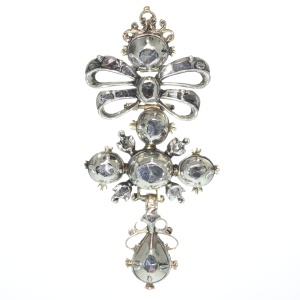
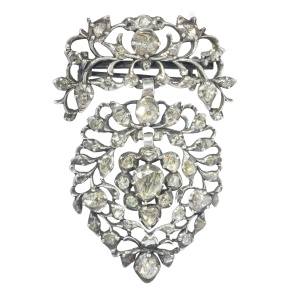
Explanation on aigrette by Adin antique jewelry
Adin Academy

Aigrette

No items found.

A gold or silver hat ornament to support a feather, or made in the form of a jewelled feather or sometimes a brooch supporting a jewelled feather.Shaped like an egret plume (hence the name), it was often almost entirely set with small gemstones, and sometimes also enamelled; it might be further adorned with light, vibrating, vertical metalstalks. A slide or vertical pin was occasionally provided, enabling the ornament to be worn in the hair or attached to a headdress.Aigrettes were in use from the 17th century until the late 18th, and again in the late 19th and early 20th centuries.

Aigrette

Aigrette (from the French for egret, or lesser white heron), the tufted crest, or head-plumes of the egret, used for adorning a woman's head-dress, the term being also given to any similar ornament, ingems. Aigrettes, studded with diamonds and rubies also decorated the turbans of Ottoman sultans or the ceremonial chamfron of their horses. Several of these aigrettes are on display in the Treasury ofthe Topkap Palace in Istanbul, Turkey.An aigrette is also worn by certain ranks of officers in the French army.By analogy the word is used in various sciences for feathery excrescences of like appearance, as for the tufts on the heads of insects, the feathery down of the dandelion, the luminous rays at the endof electrified bodies, or the luminous rays seen in solar eclipses, diverging from, the moon's edge.The 61.50 carat (12.3 g) whiskey-coloured diamond, "The Eye of the Tiger", was mounted by Cartier in a turban aigrette for the Jam Saheb or Maharajah of Nawanagar in 1934.
Also known as:

References

From: An Illustrated Dictionary of Jewelry, autor: Harold Newman, publishers: Thames and HudsonFrom: Wikipedia