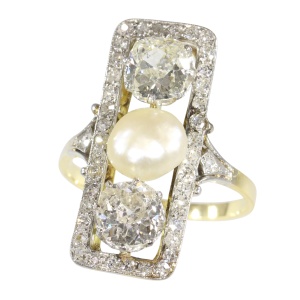

A variety of non-nucleated cultured pearls produced since World War II by means of the fresh-water mussel (Hyriopsis schlegeli) in Lake Biwa,Honshu, Japan.Owing to the internal anatomy of the mussel, a solid foreign nucleus cannot readily be inserted, so that a small piece of mantle tissue (which later disappears) from another mussel is inserted ineach of ten to twenty incisions in the mantle of the host mussel, which then, in about 1 to 2 years, produces the pearls.They are brown or salmon coloured, and seldom spherical; they are bleached to a bright white. The process is repeated in some mussels, producing larger and darkerbaroque pearls.Comparable non-nucleated cultured pearls have also been produced since 1958 in Australia by using a large variety of pearl oyster (Pinctada maxima).
Biwa Pearl
Biwa Pearl
A variety of non-nucleated cultured pearls produced since World War II by means of the fresh-water mussel (Hyriopsis schlegeli) in Lake Biwa,Honshu, Japan.Owing to the internal anatomy of the mussel, a solid foreign nucleus cannot readily be inserted, so that a small piece of mantle tissue (which later disappears) from another mussel is inserted ineach of ten to twenty incisions in the mantle of the host mussel, which then, in about 1 to 2 years, produces the pearls.They are brown or salmon coloured, and seldom spherical; they are bleached to a bright white. The process is repeated in some mussels, producing larger and darkerbaroque pearls.Comparable non-nucleated cultured pearls have also been produced since 1958 in Australia by using a large variety of pearl oyster (Pinctada maxima).
References
From: An Illustrated Dictionary of Jewelry, autor: Harold Newman, publishers: Thames and Hudson