
1. Introduction
Edwardian jewellery, often dated circa 1901 to 1915, takes its name from the reign of King Edward VII (1901 to 1910) and reflects the world of court, theatre and high society in the early twentieth century. It is the last major phase of traditional craftsmanship before the First World War reshaped taste and production.
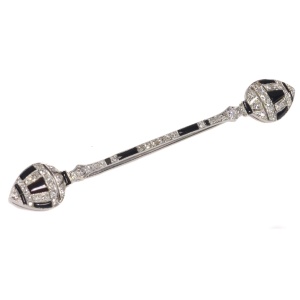
Technically assured yet visually restrained, it favours platinum and other white metals worked into fine openwork, with diamonds and pearls arranged in luminous lace-like compositions. Eighteenth century French court ornament and classical motifs return as garlands, bows and wreaths, translated into light, symmetrical jewels.
2. Cultural and Historical Influences
The Edwardian style developed during a period of prosperity and confidence in Britain and Western Europe. It draws on eighteenth century Rococo refinement and contemporary Belle Époque taste, combining aristocratic manners with modern materials and techniques.
Advances in platinum working and diamond cutting made unusually fine settings and delicate openwork possible. By the mid 1910s this culture of ease was ending, and jewellery moved towards new priorities amid the pressures of war and modernity.
3. Aesthetic Characteristics
Platinum became the preferred metal because its strength allowed very fine openwork settings that read as metal lace. Millegrain edges, fine openwork (often described as filigree), pavé and grain setting, and knife edge or collet mounts add texture without heaviness, while integrated clasps and fittings are designed to remain discreet.
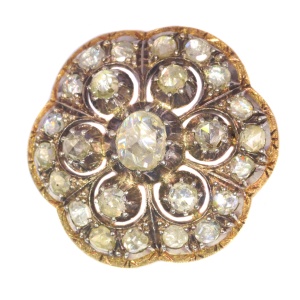
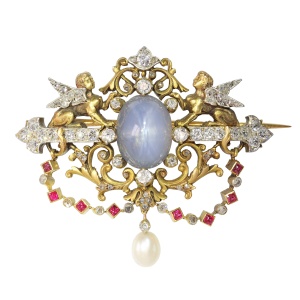
Diamonds dominate, often in mixed cuts and graduated sizes, paired with natural pearls for a soft lustre. Motifs are usually arranged with graceful symmetry: garlands and swags, bow knots, ribbon motifs, ribbon tied hearts, laurel and floral wreaths, tassels and negligee drops, floral sprays, dog collar bands with repeated units, and tiaras built from bow and wreath patterns. Occasional coloured stones such as sapphires, emeralds and aquamarines add gentle contrast.
4. Function and Meaning
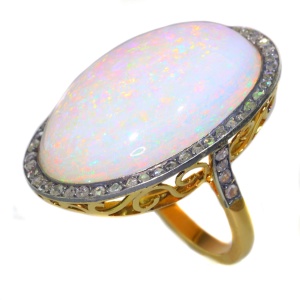
Court life, theatre and evening culture favoured jewels that conveyed grace rather than weight. Typical pieces include tiaras, brooches and negligee pendants for formal wear, as well as dog collar necklaces, pendant brooches and slender rings, often combining diamonds, pearls and fine metalwork. British firms such as Garrard and Child & Child are associated with this discreet high society taste.
The frequent white-on-white palette of platinum with diamonds or pearls was read as refined and pure. Bows, wreaths, garlands and laurel leaves recall classical ideas of beauty and harmony, while hearts and ribbons suggest affection and loyalty.
At the same time it is important to remember that perhaps most Edwardian jewellery pieces were created and worn simply because their materials, colours or forms appealed, without any further intention than beauty and attraction.
5. Notable Creators and Exemplary Pieces
Leading houses such as Cartier, Garrard and Fabergé are associated with Edwardian refinement and technical mastery. Cartier’s Garland Style jewels set a benchmark for platinum mountings and flowing bow and wreath motifs, while French jewellers such as Boucheron and Chaumet developed closely related Belle Époque interpretations.
6. How to Recognise the Style
Edwardian jewels are recognised for their lightness, symmetry and intricate white metalwork with a lacework effect, with diamonds and pearls set in openwork settings that appear almost weightless. Clasps and fittings are usually discreet, and the impression is luminous elegance, less architectural than Art Deco and more refined than late Victorian design.
7. Related Styles and Legacy
Edwardian jewellery follows from late Victorian delicacy but introduces a new lightness made possible by white metals, especially platinum and platinum-iridium alloys, with white gold alloys appearing towards the end of the period. It overlaps with Belle Époque jewellery in France and shares many motifs with the emerging Garland Style.
After the First World War, especially from the early 1920s, the structured geometry of Art Deco replaced much of its flowing grace, but the Edwardian pursuit of refinement and precision continued to influence fine jewellery through the twentieth century. Its craftsmanship and lace-like beauty remain among the jeweller’s highest achievements.
8. Purpose of This Page
This page offers an overview of the historical Edwardian jewellery style within the context of jewellery history and design. It focuses on what is relevant from the perspective of the jewellery world and does not aim to be a full encyclopaedia on the Edwardian jewellery style. Instead, it strives to offer a concise and structured introduction that outlines key interpretive angles and points towards deeper study. This page is part of the Adin Glossary, a curated resource that brings documented historical knowledge into an ordered and accessible structure. Use and sharing for educational purposes are welcomed, and readers who reference or quote this page are kindly asked to mention Adin as their source.
9. Accuracy Note
Every effort has been made to present this information accurately and in line with current historical understanding. Interpretations may evolve as new research becomes available, and readers who notice points for refinement are welcome to share their insights.
10. Author Attribution
Elkan Wijnberg, Jewellery Historian and Antique Jewellery Specialist – Adin – www.antiquejewel.com