
1. Introduction
Empire jewellery marks the culmination of French Neoclassicism under Napoleon Bonaparte. Emerging from the sober Directoire, it accompanied the shift from republic to empire, adopting a more official and monumental tone.
Rooted in Roman and Egyptian sources, the style uses classical clarity to project authority and triumph. Jewels served as courtly and political representation, combining refined workmanship with a controlled vocabulary of power.
2. Historical and Cultural Context
The Empire style arose from the political and artistic programme of Napoleonic France. After the Revolution and the austere Directoire, Napoleon sought legitimacy by invoking the authority of ancient Rome. Artists, architects and goldsmiths were encouraged to develop an antique-based visual language of power and victory. Archaeology and Enlightenment scholarship, including the influence of Winckelmann, reinforced the appeal of classical models.
Napoleon’s Egyptian campaign (1798 to 1801) introduced a parallel repertoire drawn from pharaonic art, including sphinxes, winged solar discs and lotus flowers. This Neo Egyptian vocabulary is often seen as an early major wave of Egyptian Revival in European decorative arts, later followed by further nineteenth century revivals and by Art Deco reinterpretations.
Under imperial patronage, jewellery and the decorative arts became instruments of state prestige, where symbolism, craftsmanship and propaganda were expected to align.
3. Visual Characteristics and Materials
Empire jewellery favours symmetry and clear, architectural composition. High carat gold dominates, often presented as broad polished surfaces or finely chased relief, with accents of black or dark blue enamel and a restrained palette that can include white or red enamel.
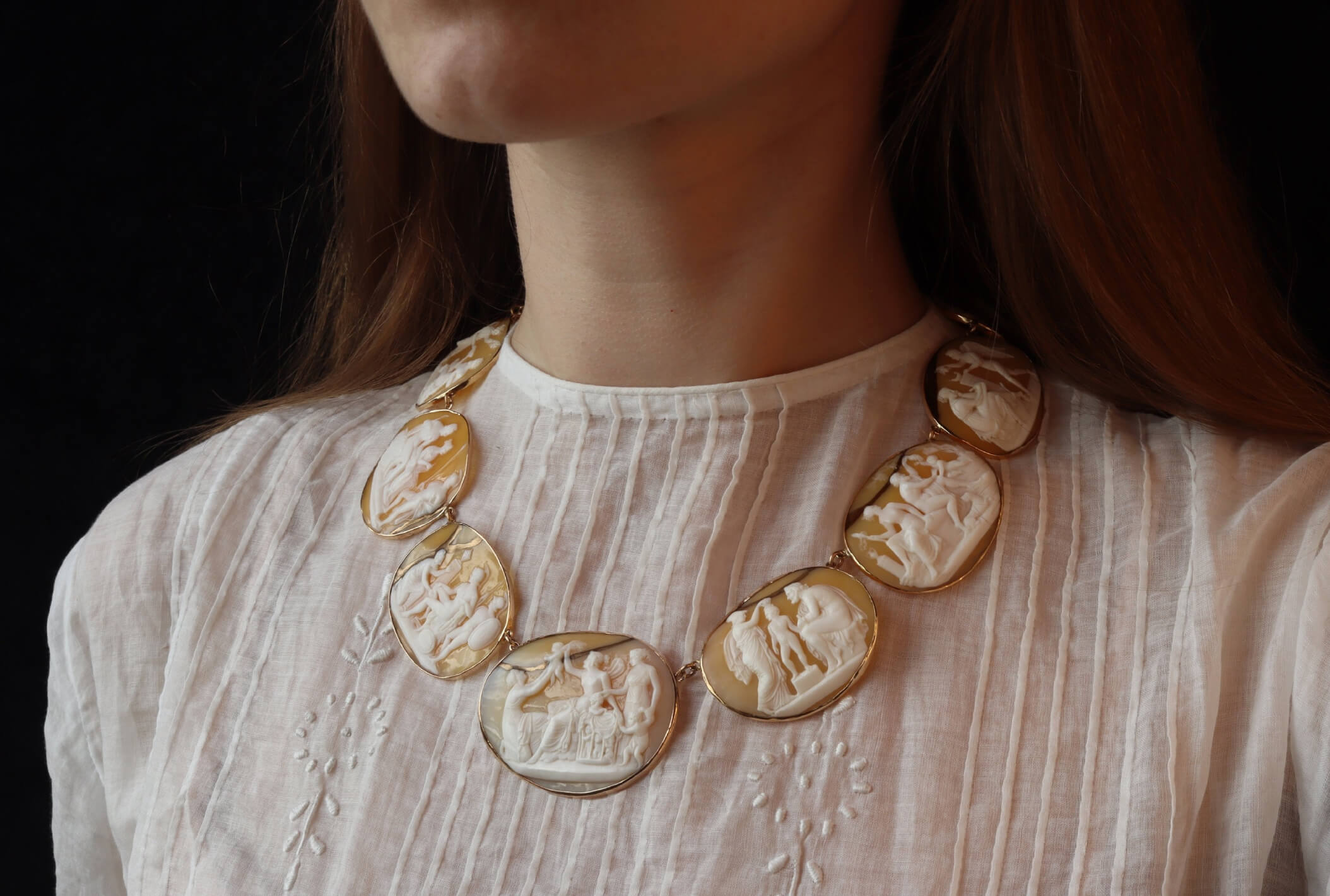
Motifs are drawn from imperial and antique sources, including laurel wreaths, eagles, palmettes, lyres, torches and classical trophies of arms. Cameos and intaglios depicting emperors, deities or allegories appear in brooches, bracelets and diadems, frequently framed by seed pearls or enamel borders. Garnets, amethysts and coral provide rich colour, and techniques such as fine wirework, enamelwork, reverse-decorated glass, engraving and chasing are used for depth and precision within a controlled design.
4. Function and Meaning
Empire jewellery translated political ideology into ornament. Motifs carried clear messages, with the eagle for imperial authority and Roman continuity, laurel wreaths and palms for victory and virtue, bees as personal emblems of Napoleon, and stars, suns and lyres for glory, harmony and the arts under imperial patronage. Gold and disciplined colour supported a deliberate sense of permanence and controlled splendour.
Many jewels also served ceremonial or official purposes, from insignia and medals of honour to presentation gifts and tokens of imperial favour, where portrait miniatures, including painted enamel portraits, and laurel framing reinforced the language of authority.
At the same time it is important to remember that perhaps most Empire jewels were created and worn simply because their materials, colours or forms appealed, without any further intention than beauty and attraction.
5. Notable Creators and Exemplary Pieces
Empire jewellery flourished under imperial patronage and close artistic supervision. In France, Martin-Guillaume Biennais and Marie-Étienne Nitot, founder of the house that later became Chaumet, supplied jewels for Napoleon and Empress Joséphine, producing parures of gold, enamel and cameos with carefully balanced imperial emblems. Related work is associated with other Parisian ateliers, where classical restraint and political symbolism were combined with a high technical finish.
Empire models were adopted across Europe. Workshops in Milan and Rome adapted French models for local courts, while Viennese jewellers developed versions rich in chased gold and garnets. In Russia, at the court of Alexander I, imported French models and locally produced jewels combined French refinement with northern luxury, sometimes with fine enamelling. Typical Empire jewels include diadems with laurel and palmette motifs, bracelets with cameos of ancient rulers, and brooches or pendants bearing eagles, bees or stars.
6. Recognition in Practice
Look for a formal, monumental version of Neoclassicism: strong symmetry, classical outlines and an architectural sense of proportion. Surfaces are often polished high carat gold, sharpened by precise chasing or engraving and set off by selective enamel in black, dark blue, white or red.
Imperial motifs are prominent, especially eagles, bees, laurel wreaths, palmettes, lyres, torches and trophies of arms, usually arranged in disciplined and balanced compositions. Cameos and intaglios are frequent and tend to be set in classical frames with enamel borders or seed pearls. Compared with earlier Neoclassical jewellery, Empire pieces appear more hierarchical and official, and their controlled geometry contrasts with the softer Romantic taste that followed.
7. Related Styles and Legacy
The Empire style was a late, formal peak of Neoclassicism and served as a model for court jewellery across Europe, from Paris and Vienna to Milan and Saint Petersburg. After Napoleon’s fall, its monumental vocabulary continued under the Bourbon Restoration, often softened into lighter interpretations of classical taste.
Later nineteenth century historicism revisited parts of the Empire language, influencing the ornamental clarity of Biedermeier and the symbolism of Victorian Neoclassicism. Its Neo Egyptian motifs resurfaced later in the nineteenth century and again in Art Deco design, demonstrating the long afterlife of the repertoire inspired by the campaign.
8. Purpose of This Page
This page offers an overview of the historical Empire jewellery style within the context of jewellery history and design. It focuses on what is relevant from the perspective of the jewellery world and does not aim to be a full encyclopaedia on the Empire jewellery style. Instead, it strives to offer a concise and structured introduction that outlines key interpretive angles and points towards deeper study. This page is part of the Adin Glossary, a curated resource that brings documented historical knowledge into an ordered and accessible structure. Use and sharing for educational purposes are welcomed, and readers who reference or quote this page are kindly asked to mention Adin as their source.
9. Accuracy Note
Every effort has been made to present this information accurately and in line with current historical understanding. Interpretations may evolve as new research becomes available, and readers who notice points for refinement are welcome to share their insights.
10. Author Attribution
Elkan Wijnberg, Jewellery Historian and Antique Jewellery Specialist – Adin – www.antiquejewel.com
%20and%20Pearl%20Gold%20Necklace-en.jpg)