
1. Introduction
Etruscan Revival jewellery is a strand of nineteenth century archaeological revival work in which jewellers echoed ancient Etruscan goldsmithing in central Italy. It is most closely associated with Roman workshops, especially the Castellani firm, whose jewels sought to recapture the look of excavated antiquities using rich yellow gold, fine wirework, and the granular surface texture of granulation.
The revival gained momentum as collectors and jewellers responded to archaeological discoveries, notably the Regolini Galassi tomb at Cerveteri, discovered still intact in 1836, and to museum displays of ancient Italian goldwork admired for filigree and granulation. The Castellani family pursued the rediscovery of granulation over decades, and marketed archaeological jewellery not only in Rome but also internationally. In the 1860s, Alessandro Castellani opened subsidiary shops in London and Paris, and the firm displayed its work and related antiquities at international expositions. In 1876, Americans first viewed the Castellani’s ancient objects and reproductions at the Centennial Exposition in Philadelphia.
In Britain, Carlo Giuliano, who worked in the Rome workshop of Alessandro Castellani, established a manufactory at 13 Frith Street in Soho, later adding retail premises at 115 Piccadilly. Through makers and retailers of this kind, archaeological revival jewellery, including Etruscan Revival taste, became established in the English market.
2. Historical and Cultural Context
Etruscan Revival jewellery sits within a broader nineteenth century appetite for archaeological revival design, fuelled by excavations, collecting, and the translation of newly studied antiquities into wearable luxury. A key reference point was the Regolini Galassi tomb at Cerveteri, discovered intact in 1836, whose goldwork became emblematic of the richness of early Etruscan jewellery. Within papal Rome, jewellers and scholars moved in the same orbit, and the Castellani were invited by papal authorities to study the tomb’s finds at first hand, a moment that helped bind technical curiosity, antiquarian scholarship, and commercial ambition into a single programme of revival making.
Although the broader nineteenth century taste for antiquity also played out in architecture and interiors, the Etruscan Revival in jewellery was driven by a mixed set of forces: archaeology, scholarship, collecting and museum display, world fairs and exhibitions, theatre and fancy dress, fashion, and the tools and workshop technologies that made fine wirework and repeatable parts practical.
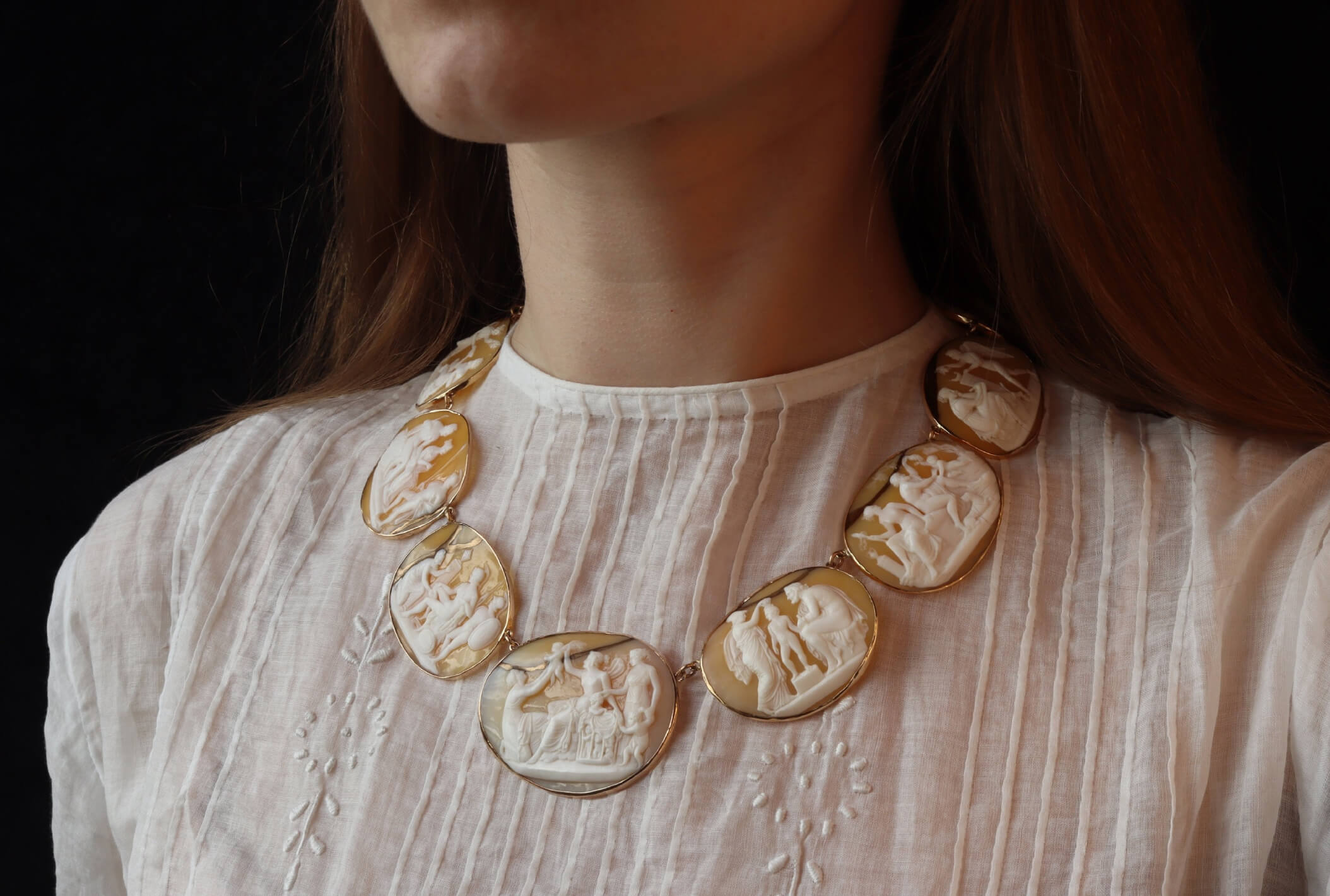
In nineteenth century usage, “Etruscan” in jewellery could denote either close models of excavated goldwork or freer reinterpretations that borrowed its most admired effects, above all granulation and fine wirework, translated into modern forms and fittings. In practice, this meant that many revival jewels were nineteenth century pieces in antique dress: pendant earrings, bracelets, brooches, lockets and parures in high carat yellow gold, sometimes with small coloured stones or cameos used to amplify the sense of antiquity rather than to dominate the design.
The success of Etruscan Revival jewellery also intersected with ideas of Italian cultural identity. Amid advocacy for national unification, the Castellani framed archaeological jewellery as a revival of a specifically Italian artistic past reaching back to the Etruscans, while Rome’s luxury tourism and exhibition culture helped turn that scholarship into desirable, portable objects for an international clientele.
Printed scholarship, museum display, and international exhibitions amplified this momentum. Public lectures, catalogues, and other publications helped circulate the look of excavated ornaments beyond those who could view the originals, while the antiquities trade and museum displays turned ancient jewellery into a recognised visual vocabulary that could be quoted, recomposed and sold. In that sense, Etruscan Revival jewellery belongs to the junction of learning and luxury: it is archaeological in reference, but modern in purpose.
3. Visual Characteristics and Materials
Etruscan Revival jewellery is most readily recognised by its warm, high carat yellow gold and its emphasis on surface texture. Jewellers used fine filigree and closely set granulation to create softly shimmering fields and patterned borders, often organised in plaques, bands, and rhythmic repeats that suggest ancient prototypes without copying any single object. This plaque and border logic translates the wider classical language of friezes and mouldings into jewellery scale, where ornament becomes structure and the piece reads as a sequence of small panels. Small classical elements, such as rosettes, palmettes, leaf scrolls, and beaded borders, are common, and some pieces incorporate cameos or coins to reinforce the archaeological mood.
Colour, when present, is usually used to support the antique effect rather than to dominate it. Small pearls, cabochons, and modest accents of coral or turquoise are typical choices, and cameos, intaglios, or ancient coins may be set as focal points to strengthen the sense of historical reference. The overall impression is less about a single large gemstone and more about the cumulative richness of gold, texture, and finely articulated detail.
The effect often depends as much on form as on surface. Earrings, bracelets, brooches, lockets, and parures are common vehicles for the style, with repeated elements and carefully balanced panels that read clearly at a distance. Even when the surface language is archaeological, the construction usually follows nineteenth century expectations of durability and wearability, with secure fittings and a regular logic of assembly.
4. Function and Meaning
Etruscan Revival jewellery functioned as a form of cultivated display. To wear it was to signal familiarity with archaeology, collecting, and the prestige of ancient Italy. For many buyers it also served as a souvenir of travel, museum visiting, or Rome’s antiquarian trade, translated into jewels for formal social settings.
At the same time it is important to remember that perhaps most Etruscan Revival jewels were created and worn simply because their materials, colours or forms appealed, without any further intention than beauty and attraction. Even when references were scholarly, the objects still needed to succeed as jewellery, pleasurable to wear, flattering in candlelight, and legible at a social distance.
5. Notable Creators and Exemplary Pieces
Among the makers, the Castellani firm is the central name. Working in Rome, they combined antiquarian study with high level goldsmithing, making filigree and granulation a recognisable signature. Their revival jewels range from close quotations of ancient forms to hybrid pieces in which classical plaques and motifs are recomposed into modern fittings intended for wear within nineteenth century dress codes.
A second important name is Carlo Giuliano. Trained in Rome before establishing his own business in London, he helped translate Roman archaeological revival taste into the English jewellery market. His work can range from explicitly Etruscan surface effects to broader classical and Renaissance revival idioms, and in a collection context it is often assessed not only by technique and motif, but also by construction, fittings, marks, and provenance.
Within the Castellani circle, archaeological revival jewellery was shaped not only by Fortunato Pio Castellani but also by his sons Alessandro and Augusto, who helped present and market this work to an international clientele. At the same time, Etruscan Revival effects were widely imitated, which means the label should be used with care. Many unsigned jewels echo granulation and filigree convincingly without being by Castellani or Giuliano, and attribution often depends on construction details, marks, and provenance rather than on motif alone.
6. How to Recognise Etruscan Revival Jewellery
The most reliable indicator is not the word “Etruscan” in a catalogue description, but the technical language of the surface. Look for dense fields of granulation that read as deliberate patterning rather than incidental roughness, for crisp filigree borders, and for plaque like construction that suggests a conscious attempt to echo an ancient gold idiom. At the same time, many nineteenth century jewels are modern in engineering, with hinged sections, box clasps, and a tidy modular logic designed for regular wear.
Because granulation was celebrated as a recovered technique, it deserves particular attention. In Etruscan Revival work, the granules are usually very regular in size and carefully placed, often forming geometric bands, rosettes, and textured grounds. Imitations can be convincing, but less successful work tends to read as too coarse, too sparse, or visually dead, either through poor placement or through a mechanically uniform effect that lacks the slight liveliness of hand placed work.
Construction and fittings remain decisive when technique alone is inconclusive. Many nineteenth century revival jewels use repeatable modules, engineered hinges, and consistent clasp systems, while genuinely ancient construction often follows different joining solutions and a different logic of durability. For attribution, treat marks, provenanced purchase history, and workshop specific construction habits as more reliable than motif choice, because the motifs were widely copied.
7. Related Styles and Legacy
Etruscan Revival jewellery helped establish archaeological jewellery as a recognisable nineteenth century taste, in which the jewel could function as a learned quotation as well as ornament. It sits within the wider landscape of Historicism, alongside Greek Revival and Renaissance Revival work, but its identity is unusually bound to gold technique, especially filigree and granulation.
Its longer legacy is less about fixed motifs and more about method. It offers a recurring model of design in which historical goldwork is treated as a technical and aesthetic resource, inviting later makers to revisit ancient surface effects, particularly granulation, as a marker of hand skill and as an alternative to gemstone led display.
8. Sources and Further Reading
Vatican Museums, “Regolini Galassi Tomb”, Museo Gregoriano Etrusco (overview page on the tomb’s discovery in 1836 and its significance).
Bard Graduate Center, “A Perfect Imitation of the Ancient Work” (short article on how the opening of the Regolini Galassi tomb in 1836 influenced the Castellani, including papal access and the firm’s turn to ancient goldwork).
The Metropolitan Museum of Art, Heilbrunn Timeline of Art History, “The Castellani and Italian Archaeological Jewelry” (overview of the firm and its role in archaeological revival jewellery, including international expansion).
British Museum, “Carlo Giuliano” (biographical entry noting his work in Alessandro Castellani’s Rome workshop and his opening of a manufactory at 13 Frith Street, Soho, in 1860).
British Museum, “Castellani” (biographical entry on Fortunato Pio Castellani, with basic firm context and dates, useful as a compact reference point for names and chronology).
9. Purpose of This Page
This page provides an overview of Etruscan Revival jewellery within the context of jewellery history and design. It focuses on what is most relevant from a jewellery perspective and does not aim to be a full encyclopaedia of the Etruscan Revival. Instead, it offers a concise and structured introduction that highlights key interpretive angles and points towards deeper study.
This page is part of the Adin Jewellery Glossary and is also included in the Adin Styles Overview, where each style is presented with curated reference fields for browsing and comparison. Use and sharing for educational purposes are welcomed. If you reference or quote this page, please mention Adin as your source.
10. Accuracy Note
Every effort has been made to present this information accurately and in line with current historical understanding. Interpretations may evolve as new research becomes available, and readers who notice points for refinement are welcome to share their insights.
11. Author Attribution
Elkan Wijnberg, Jewellery Historian and Antique Jewellery Specialist – Adin – www.antiquejewel.com