
Adin Glossary: Styles and periods

Greek jewellery

circa 700 BCE to 31 BCE, laurel, olive, mythic figures, geometric borders

1. Introduction

The Greek style covers the jewellery of ancient Greece from the Archaic period through the Classical period and into the Hellenistic age, broadly ending with the close of the Hellenistic period. Across these phases it is marked by an interest in ideal proportions, geometric clarity and controlled naturalism.

Greek craftsmen developed forms, ornament and gem engraving that expressed balance and harmony, shaping a visual language central to the classical world. These principles influenced Roman production and continued to inform European art for centuries.

2. Historical and cultural context

The Greek style developed in a Mediterranean world of independent city states, where religion, civic identity and artistic competition played central roles. Mythology provided a wide range of subjects, while sanctuaries and festivals created a sustained demand for finely crafted objects.

Trade networks linked Greece to Egypt, Asia Minor and the wider Mediterranean, encouraging the exchange of materials and techniques. Workshops shared ideas through apprenticeships, travel and the movement of skilled craftsmen, creating a coherent aesthetic that later served as a foundation for classical art across the region.

3. Visual characteristics and materials

Across the Archaic, Classical and Hellenistic periods, Greek jewellery favours geometric order and refined naturalism. Motifs such as the meander, palmette, rosette and acanthus appear in balanced arrangements, often framed by geometric borders and controlled scrolls.

Figures are rendered with disciplined clarity, with attention to anatomy and rhythmic movement, and this precision extends to gem engraving, including intaglio cutting. Materials include high carat gold and silver, engraved gemstones, coloured stones and glass inlays.

Techniques include filigree, granulation, repoussé and chasing in gold and precise gem engraving. Surfaces are smoothly modelled or enriched with filigree and granulation, and forms tend to follow simple, harmonious shapes rather than excessive ornament.

4. Function and meaning

Greek jewellery operated within a social and religious framework where objects could serve ritual and civic purposes. Symbolism is closely linked to mythology, civic identity and the ideal values associated with classical culture. At the same time it is important to remember that perhaps most jewels of the Greek jewellery style were created and worn simply because their materials, colours or forms appealed, without any further intention than beauty and attraction.

Figures of gods and heroes could suggest strength, protection or virtue, while motifs such as the meander expressed continuity and order. Laurel and olive branches referred to honour, victory or sacred associations with particular deities, while natural forms conveyed harmony and balance rather than decorative abundance.

5. Notable creators and exemplary pieces

Greek jewellery was produced in workshops whose individual makers are rarely recorded, although regional traditions can be identified. Workshops in Ionia and Attica are associated with fine filigree and granulation, while Hellenistic centres such as Alexandria and Rhodes produced some of the most elaborate constructions and naturalistic modelling.

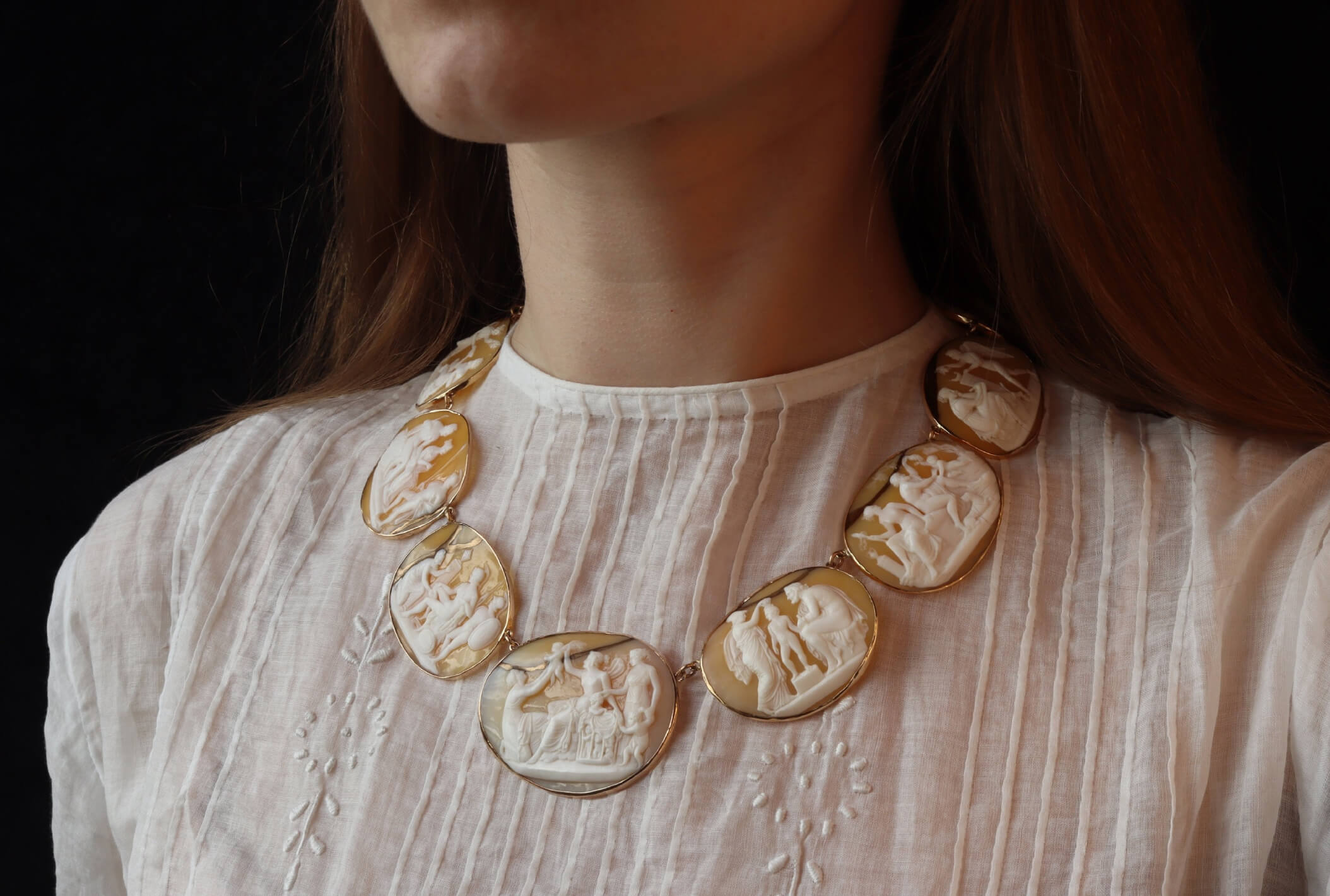
Typical pieces include earrings with delicate rosettes, pendants shaped as miniature figures or animals, and rings engraved with mythological subjects. These objects show technical precision and refined ornament.

6. Recognition in practice

Greek pieces are often recognisable by a combination of ideal proportions, geometric clarity and controlled naturalism. Look for balanced compositions that use the meander, palmette, rosette and acanthus, with clean outlines and a disciplined arrangement of ornament.

Intaglio rings can show precise carving of mythological or symbolic subjects. Fine filigree and granulation, fine sheet gold work in high carat gold, and restrained, harmonious forms support an overall impression of order and visual balance.

7. Related styles and legacy

The Greek style forms a foundation for the classical tradition in Western art and influenced later periods. Roman craftsmen adopted and adapted Greek forms, contributing to the broader Greco Roman aesthetic.

Greek principles of proportion and harmony were revived and studied during the Renaissance, and reappeared in the eighteenth and nineteenth centuries in Neoclassicism and archaeological movements. Despite later reinterpretations, the Greek style remains defined by its ancient context and the artistic ideals that shaped Mediterranean visual culture.

8. Purpose of This Page

This page offers an overview of the historical Greek jewellery style within the context of jewellery history and design. It focuses on what is relevant from the perspective of the jewellery world and does not aim to be a full encyclopaedia on the Greek jewellery style. Instead, it strives to offer a concise and structured introduction that outlines key interpretive angles and points towards deeper study. This page is part of the Adin Glossary, a curated resource that brings documented historical knowledge into an ordered and accessible structure. Use and sharing for educational purposes are welcomed, and readers who reference or quote this page are kindly asked to mention Adin as their source.

9. Accuracy Note

Every effort has been made to present this information accurately and in line with current historical understanding. Interpretations may evolve as new research becomes available, and readers who notice points for refinement are welcome to share their insights.

10. Author Attribution

Elkan Wijnberg, Jewellery Historian and Antique Jewellery Specialist – Adin – www.antiquejewel.com
Balanced Greek ornaments, meanders and palmettes, in high carat gold with filigree, granulation and precise intaglio carving for rings and pendants.

circa 700 BCE to 31 BCE

Greek city state culture, Greek religion and sanctuaries, classical mythology, civic identity and festivals, Mediterranean trade networks, contacts with Egypt and Asia Minor, artistic competition and workshops, Hellenistic royal courts

Greece, Turkey, Egypt

meanders, palmettes, rosettes, acanthus leaves, laurel wreaths, olive branches, idealised gods and heroes, mythological scenes, animal and figure pendants, geometric borders and scrolls

high carat gold, silver, engraved gemstones, coloured stones, glass inlays

filigree, granulation, repoussé and chasing in gold, precise gem engraving and intaglio cutting

Greco-Roman, Classical, Neoclassicism, Directoire, Empire, Archaeological Revival, Etruscan Revival

Classical & Antiquarian Classicism (ancient formal language as the core)

Adin Academy

Greek jewellery

No items found.

1. Introduction

The Greek style covers the jewellery of ancient Greece from the Archaic period through the Classical period and into the Hellenistic age, broadly ending with the close of the Hellenistic period. Across these phases it is marked by an interest in ideal proportions, geometric clarity and controlled naturalism.

Greek craftsmen developed forms, ornament and gem engraving that expressed balance and harmony, shaping a visual language central to the classical world. These principles influenced Roman production and continued to inform European art for centuries.

2. Historical and cultural context

The Greek style developed in a Mediterranean world of independent city states, where religion, civic identity and artistic competition played central roles. Mythology provided a wide range of subjects, while sanctuaries and festivals created a sustained demand for finely crafted objects.

Trade networks linked Greece to Egypt, Asia Minor and the wider Mediterranean, encouraging the exchange of materials and techniques. Workshops shared ideas through apprenticeships, travel and the movement of skilled craftsmen, creating a coherent aesthetic that later served as a foundation for classical art across the region.

3. Visual characteristics and materials

Across the Archaic, Classical and Hellenistic periods, Greek jewellery favours geometric order and refined naturalism. Motifs such as the meander, palmette, rosette and acanthus appear in balanced arrangements, often framed by geometric borders and controlled scrolls.

Figures are rendered with disciplined clarity, with attention to anatomy and rhythmic movement, and this precision extends to gem engraving, including intaglio cutting. Materials include high carat gold and silver, engraved gemstones, coloured stones and glass inlays.

Techniques include filigree, granulation, repoussé and chasing in gold and precise gem engraving. Surfaces are smoothly modelled or enriched with filigree and granulation, and forms tend to follow simple, harmonious shapes rather than excessive ornament.

4. Function and meaning

Greek jewellery operated within a social and religious framework where objects could serve ritual and civic purposes. Symbolism is closely linked to mythology, civic identity and the ideal values associated with classical culture. At the same time it is important to remember that perhaps most jewels of the Greek jewellery style were created and worn simply because their materials, colours or forms appealed, without any further intention than beauty and attraction.

Figures of gods and heroes could suggest strength, protection or virtue, while motifs such as the meander expressed continuity and order. Laurel and olive branches referred to honour, victory or sacred associations with particular deities, while natural forms conveyed harmony and balance rather than decorative abundance.

5. Notable creators and exemplary pieces

Greek jewellery was produced in workshops whose individual makers are rarely recorded, although regional traditions can be identified. Workshops in Ionia and Attica are associated with fine filigree and granulation, while Hellenistic centres such as Alexandria and Rhodes produced some of the most elaborate constructions and naturalistic modelling.

Typical pieces include earrings with delicate rosettes, pendants shaped as miniature figures or animals, and rings engraved with mythological subjects. These objects show technical precision and refined ornament.

6. Recognition in practice

Greek pieces are often recognisable by a combination of ideal proportions, geometric clarity and controlled naturalism. Look for balanced compositions that use the meander, palmette, rosette and acanthus, with clean outlines and a disciplined arrangement of ornament.

Intaglio rings can show precise carving of mythological or symbolic subjects. Fine filigree and granulation, fine sheet gold work in high carat gold, and restrained, harmonious forms support an overall impression of order and visual balance.

7. Related styles and legacy

The Greek style forms a foundation for the classical tradition in Western art and influenced later periods. Roman craftsmen adopted and adapted Greek forms, contributing to the broader Greco Roman aesthetic.

Greek principles of proportion and harmony were revived and studied during the Renaissance, and reappeared in the eighteenth and nineteenth centuries in Neoclassicism and archaeological movements. Despite later reinterpretations, the Greek style remains defined by its ancient context and the artistic ideals that shaped Mediterranean visual culture.

8. Purpose of This Page

This page offers an overview of the historical Greek jewellery style within the context of jewellery history and design. It focuses on what is relevant from the perspective of the jewellery world and does not aim to be a full encyclopaedia on the Greek jewellery style. Instead, it strives to offer a concise and structured introduction that outlines key interpretive angles and points towards deeper study. This page is part of the Adin Glossary, a curated resource that brings documented historical knowledge into an ordered and accessible structure. Use and sharing for educational purposes are welcomed, and readers who reference or quote this page are kindly asked to mention Adin as their source.

9. Accuracy Note

Every effort has been made to present this information accurately and in line with current historical understanding. Interpretations may evolve as new research becomes available, and readers who notice points for refinement are welcome to share their insights.

10. Author Attribution

Elkan Wijnberg, Jewellery Historian and Antique Jewellery Specialist – Adin – www.antiquejewel.com
Also known as:

References