
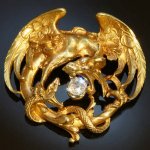
See our: griffin jewelry or ourmythological jewelry.The griffin (also spelled as "gryphon" or "griffon") is originally a Greek hybrid creatureA hybrid is a composite of two or more species of animal and/or human. Strange as they may appear, the Greeks were endlessly fond of fabricating these creatures, one will recognize hybrids inthe earliest myths and legends, not to mention inhabiting numerous works of art. For the Greeks especially, these beings of the imagination must have had great significance, in that they representedthe uncivilized forces in nature that opposed mankind.
The seven most known hybrids are:
The centaur - In Greek mythology and art, the centaur has the torso of a human combined with the body of a horse.The cockatrice - this creature was also known as a basilisk ("king of serpents"), and its very glance could kill; the cockatrice was composed of a dragon's tail and assorted poultry parts.The giants (gigantes) - These fierce and frightening beings were the offspring of Gaia (the Earth).The griffin - According to myth, the griffin was a creature with a lion's body attached to the head, wings, and claws of an eagle.The harpy - Harpies had female torsos melded with vulture parts; the name harpy is derived from the Greek word that means "snatcher".The satyrs (faun) - Satyrs were often the companions of Dionysos, and these creatures were depicted in myth and art with the legs of goats and bestial natures.The sirens - Women with bird-like bodies; sirens were legendary for luring sailors by singing their enchanted songs.The griffin is a mythical creature with the face, beak, talons and wings of an eagleand the body of a lion. At times, it is portrayed with a long snake-like tail. In some traditions, only the female has wings.Its nests are made of gold and its eggs resemble agates. Pliny believed griffins came from Northern Russia;Aeschylus thought they originated in Ethiopia; and Bullfinch wrote that their native country was India.In its body, the griffin is blessed with the speed, flight, and penetrating vision of the eagleand the strength, courage, and majesty of the lion.In symbolism, the griffin combines the symbolic qualities of both the lion and the eagle.It is the king of birds and lord of the air united with the king of beasts and lord of the earth.The griffin's dual nature led it to be associated with Jesus Christ, God and man, king of heaven and earth. The eagle half of the griffin signified Christ's divinity and the lion half represented His humanity. Because no one could block the path of a griffin, this creature was especially associated with that passage in the Gospel which records Christ's marvelous passage through the crowd at Nazareth who were determined to throw Him off a cliff. [Luke 4:28-30] During the Middle Ages, griffins were symbols of Christ's resurrection. The strength of the lion and the wisdom of the eagle combined in the griffin symbolized the strength and wisdom of God.The logical difficulties of duality, led some people to see in the griffin the perversion of thestrengths of both animals. Gevaert theorized that the combination of lion and eagle parts would more orless cripple the griffin, depriving him of the ability to fly unencumbered like the eagle or walk nobly likethe lion. It was associated with those who used their powers to persecute the Christians, evil personified,the Antichrist,and the Devil. There was even an imaginary creature called the griffin-dragon who had thetail of a dragon or a snake. This one always represented evil.One legend involving griffins is the Ascension of Alexander the great. According to this story, Alexandercaptured a pair of griffins and, having starved them for three days, hitched them to histhrone and, teasing them with chunks of roast beef held above their heads on lances, flew heavenwardfor seven days. Alexander would've stolen a peek at God Himself if an angel had not asked himwhy he wanted to see the things of heaven when he did not yet understand the things of earth. Chastised forhis presumptuousness, Alexander flew back to earth. Representations of Alexander's ascension were placedin French and Italian cathedrals during the 12th century.The griffin's ability to soar like an eagle made him an emblem of poetic and spiritual inspiration. Theeagle parts of the griffin represented the saints with their thoughts, aspirations, and souls liftedtowards God. Its lion half stood for their courage in the arena and in the continuing struggle against sin,evil, and the Devil. As emblems of the saints, griffins are sometimes pictured eating fruit picked from theTree of Life. [see Rev 2:7]During captivity, Israelites would have become familiar with the griffin image. Both Persians and Assyriansdecorated with images of this magical beast. Images of two griffins drinking from a flaming cup werecommon in the Persian religion, Zorastrianism. Later, the Crusaders, coming across this image, would bereminded of the Eucharist and the cup of fire became associated with the Holy Grail.During the Middle Ages, Christian nobles searched for griffin's eggs or "grypeseye" which they mounted andused for cups, believing they brought health to any beverage.Because of the griffin's strength and powers of sight, it was believed to guard hidden treasures andhide them in their nests with their young. Because of its association with the Holy Grail, oneof the treasures most commonly guarded by griffins was emeralds. (The Holy Grail was carvedfrom a single emerald. It was used to hold the wine at the Last Supper and believedto have magical powers.) Other popular treasures guarded by griffins were the Tree ofLife, knowledge, and the roads to salvation. Greeks and Romans used griffin images to guard tombs.Griffins are a symbol of the sun, wisdom, vengeance, strength, and salvation.