
Hades

This glossary entry has not yet been updated and is under review.

Hades (from Greek, originally Haides or Aides, probably from Indo-European refers both to the ancient Greek underworld, the abode of Hades, and to the god of the dead himself. Hades in Homer referredjust to the god; Haidou its genitive, was an elision of "the house of Hades." Eventually, the nominative, too, came to designate the abode of the dead.In Greek mythology, Hades and his brothers Zeus and Poseidon defeated the Titans and claimed rulership over the universe ruling the underworld, sky, and sea, respectively. Because of his associationwith the underworld, Hades is often interpreted as a grim figure.Hades was also called Plouto (from Greek "Plouton"), and by this name known as "the unseen one", or "the rich one". In Roman mythology, Hades/Pluto was called Dis Pater and Orcus. The correspondingEtruscan god was Aita. The symbols associated with him are the bident and the three-headed dog, Cerberus.In Christian theology, the term hades refers to the abode of the dead, where the dead await Judgement Day either at peace or in torment (see Hades in Christianity below).

Persephone

The consort of Hades, and the archaic queen of the Underworld in her own right, before the Hellene Olympians were established, was Persephone, represented by the Greeks as daughter of Zeus and Demeter.Persephone did not submit to Hades willingly, but was abducted by him while picking flowers with her friends. Persephone's mother missed her and without her daughter by her side she cast a curse onthe land and there was a great famine. Hades tricked Persephone into eating pomegranate seeds (though some stories say they fell in love and to ensure her return to him, he gave her the pomegranateseeds): "But he on his part secretly gave her sweet pomegranate seed to eat, taking care for himself that she might not remain continually with grave, dark- robed Demeter."Demeter questioned Persephone on her return to light and air: "...but if you have tasted food, you must go back again beneath the secret places of the earth, there to dwell a third part of the seasonsevery year: yet for the two parts you shall be with me and the other deathless gods."Thus every year Hades fights his way back to the land of the living with Persephone in his chariot. Famine (autumn and winter) occurs during the months that Persephone is gone and Demeter grieves inher absence. It is believed that the last half of the word Persephone comes from a word meaning 'to show' and evokes an idea of light. Whether the first half derives from a word meaning 'to destroy' -in which case Persephone would be 'she who destroys the light.'See also: Olympian gods

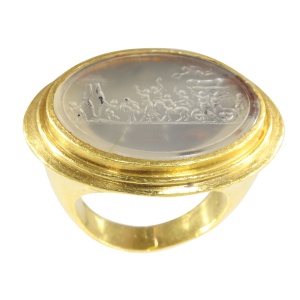
Explanation on hades by Adin antique jewelry
Adin Academy

Hades

No items found.

Hades (from Greek, originally Haides or Aides, probably from Indo-European refers both to the ancient Greek underworld, the abode of Hades, and to the god of the dead himself. Hades in Homer referredjust to the god; Haidou its genitive, was an elision of "the house of Hades." Eventually, the nominative, too, came to designate the abode of the dead.In Greek mythology, Hades and his brothers Zeus and Poseidon defeated the Titans and claimed rulership over the universe ruling the underworld, sky, and sea, respectively. Because of his associationwith the underworld, Hades is often interpreted as a grim figure.Hades was also called Plouto (from Greek "Plouton"), and by this name known as "the unseen one", or "the rich one". In Roman mythology, Hades/Pluto was called Dis Pater and Orcus. The correspondingEtruscan god was Aita. The symbols associated with him are the bident and the three-headed dog, Cerberus.In Christian theology, the term hades refers to the abode of the dead, where the dead await Judgement Day either at peace or in torment (see Hades in Christianity below).

Persephone

The consort of Hades, and the archaic queen of the Underworld in her own right, before the Hellene Olympians were established, was Persephone, represented by the Greeks as daughter of Zeus and Demeter.Persephone did not submit to Hades willingly, but was abducted by him while picking flowers with her friends. Persephone's mother missed her and without her daughter by her side she cast a curse onthe land and there was a great famine. Hades tricked Persephone into eating pomegranate seeds (though some stories say they fell in love and to ensure her return to him, he gave her the pomegranateseeds): "But he on his part secretly gave her sweet pomegranate seed to eat, taking care for himself that she might not remain continually with grave, dark- robed Demeter."Demeter questioned Persephone on her return to light and air: "...but if you have tasted food, you must go back again beneath the secret places of the earth, there to dwell a third part of the seasonsevery year: yet for the two parts you shall be with me and the other deathless gods."Thus every year Hades fights his way back to the land of the living with Persephone in his chariot. Famine (autumn and winter) occurs during the months that Persephone is gone and Demeter grieves inher absence. It is believed that the last half of the word Persephone comes from a word meaning 'to show' and evokes an idea of light. Whether the first half derives from a word meaning 'to destroy' -in which case Persephone would be 'she who destroys the light.'See also: Olympian gods

Also known as:

References

From: Wikipedia