
1. Introduction
Historic Revival jewellery reflects the nineteenth century fascination with Europe's artistic past, in a period when archaeology, museums, exhibitions and printed scholarship made earlier styles newly visible to designers and the wider public. It is most typical from circa 1830 to 1900, with continuations into the early twentieth century.
Rather than copying medieval, Renaissance, Baroque or Rococo forms directly, makers reinterpreted them through nineteenth century craftsmanship, taste and technology. The resulting jewels engage deliberately with inherited form, often projecting cultural identity, historical awareness and admiration for earlier workmanship in an age of industrial expansion.
2. Cultural and Historical Influences
Historic Revival jewellery is closely tied to nineteenth century scholarship. Archaeological discoveries, the cataloguing of museum collections and the publication of design compendia and pattern books made earlier ornament accessible for jewellers across Europe. Architectural restorations and international exhibitions further encouraged historicising design.
Several parallel forces fed this revival in jewellery. Archaeology and scholarship provided forms and methods, private collecting and museum display offered direct models, and world fairs and exhibitions helped spread historicising taste. Theatre and costume, fashion plates and illustrated journals further translated earlier ornament into wearable motifs. Advances in workshop practice and technology made these references easier to execute in metal, enamel and gem setting. Architecture mattered too, but as one contributor within this wider culture of looking back, rather than as the single engine.
National currents shaped emphasis and style. In Britain, the Gothic Revival influenced architecture, decorative arts and jewellery through the wider movement associated with figures such as A.W.N. Pugin. In France, state patronage and major museums encouraged renewed attention to Renaissance metalwork and enamelling. In Germany and Austria, historicism often took a more academic tone, aligned with university scholarship and with emerging national identity.
Industrialisation also played a role. As mechanised production expanded, revivalist design offered an anchor in craftsmanship, history and tradition, functioning both as cultural expression and an artistic response to modernity.
3. Visual Characteristics, Materials and Techniques
Historic Revival jewellery draws most of its vocabulary from Gothic, Renaissance, Baroque and Rococo ornament, informed by manuscript illumination, metalwork, architecture and the decorative arts. In jewellery, this wider design language is translated into small scale construction through pierced openwork, applied elements, sculptural relief and enamelled panels that carry historic motifs across brooches, pendants, lockets, bracelets and earrings.
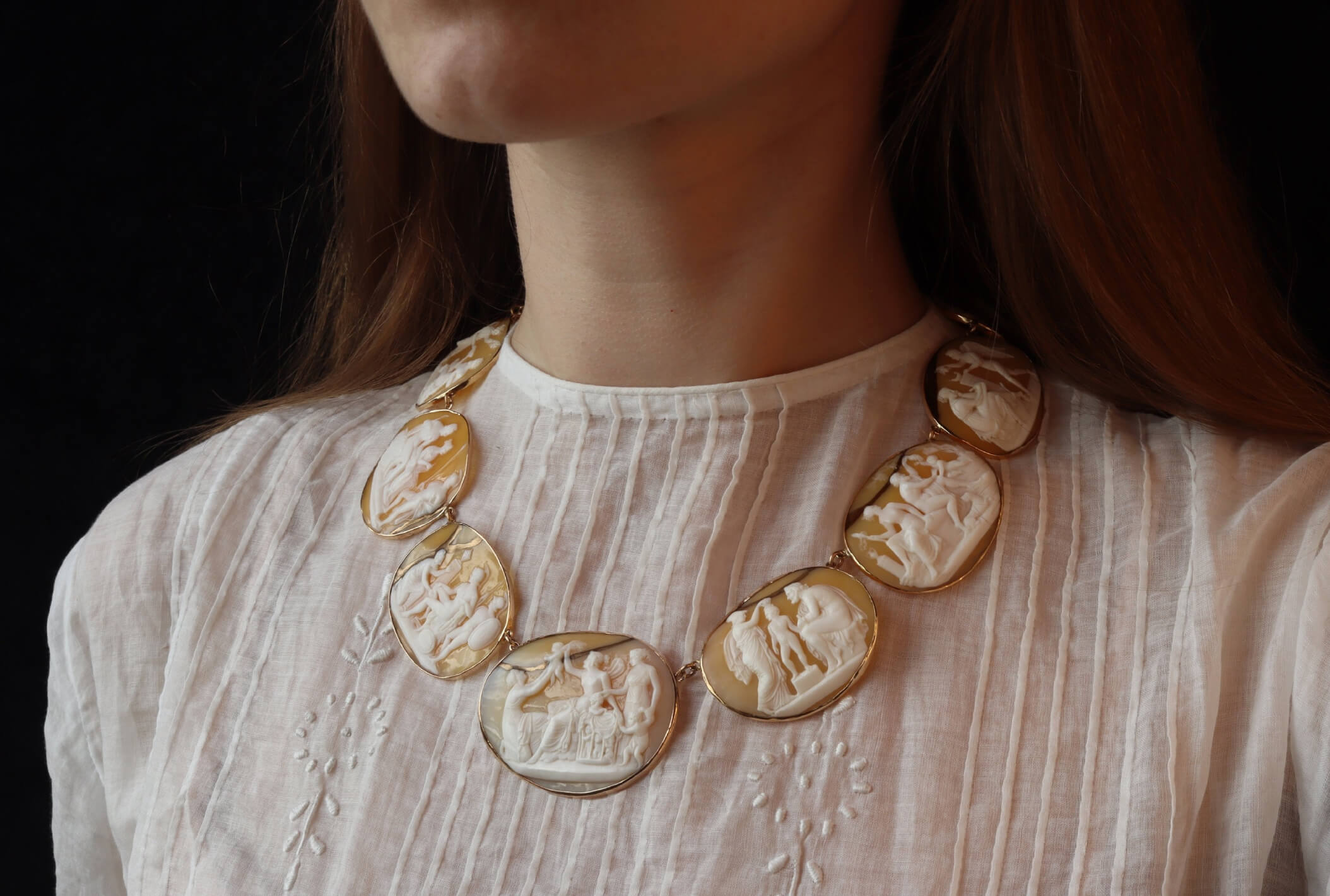
Gothic reinterpretations use pointed arches, tracery, trefoils, quatrefoils and medieval foliage, sometimes highlighted with enamel. Renaissance-inspired designs often favour symmetrical compositions, scrollwork, cartouches, masks, mythological figures, cameos or intaglios, and enamel techniques such as basse taille. Baroque revival pieces adopt heavier curves, volutes, sculptural modelling and dramatic contrast, while Rococo variants tend towards lighter ornament, C scrolls and controlled asymmetry.
Across these revivals, high carat gold, silver and silver gilt are worked with deliberate detail through casting, chasing, engraving and careful modelling that echo earlier craftsmanship while remaining distinctly nineteenth century in finish and regularity. Enamel frequently provides colour and definition, gemstones are often integrated as accents within ornamental frameworks, and some pieces show micromosaic, hardstone or granulated decoration where Historic Revival taste approaches the Archaeological Revival without fully becoming it.
4. Function and Meaning
Historic Revival jewellery tends to convey meaning through cultural association rather than personal symbolism. Gothic-inspired designs could suggest piety, medieval romance or scholarly taste. Renaissance revivals evoke humanism, learning and classical balance, while Baroque and Rococo variants carry connotations of courtly splendour, artistic refinement and display.
Rather than embedding coded messages, these jewels often express admiration for historical craftsmanship and intellectual engagement with the past. At the same time it is important to remember that many Historic Revival jewels were created and worn simply because their materials, colours or forms appealed, without any further intention than beauty and attraction. They could nonetheless signal education, cultural curiosity and alignment with broader artistic movements in architecture and design, as part of a shared visual culture linking past and present.
5. Notable Creators and Exemplary Pieces
Historic Revival jewellery flourished across Europe, supported by both court workshops and independent ateliers.
In France, Froment-Meurice, Jules Wièse and the house of Falize produced Renaissance Revival and Gothic-inspired pieces noted for fine enamelling, sculptural detail and historical refinement. In Britain, designers and makers including John Brogden and Phillips Brothers applied Gothic tracery, medieval motifs and Neo-Renaissance ornament to lockets, brooches and pendants. In Austria and Germany, academic interest in medieval craftsmanship informed historicist work that combined precision with scholarly ambition.
The Italian Castellani family, best known for the Archaeological Revival, also contributed significantly through research, museum engagement and a broader nineteenth century understanding of historical goldsmithing traditions. Typical pieces include enamelled pendants with architectural motifs, Renaissance-inspired lockets with scrollwork and figures, brooches framed by Gothic openwork, and sculptural gold jewels that adapt historical ornament to wearable scale.
6. How to Recognise the Style
Historic Revival jewellery is identified by clear quotation of earlier European ornament, most often Gothic, Renaissance, Baroque or Rococo in both reference and detail.
Look for architectural openwork such as tracery, arches, arcades, cartouches or panel-like framing, combined with nineteenth century precision in metalwork, fittings and stone setting. Compared with genuine medieval or Renaissance jewels, nineteenth century revivals are generally more regular in workmanship, often larger in scale and unmistakably shaped by contemporary taste and manufacture.
7. Legacy and Related Styles
Historic Revival jewellery sits at the centre of nineteenth century artistic culture. It intersects with the Archaeological Revival, which focused more directly on ancient techniques and classical ornament, and overlaps with named subcurrents such as Neo-Gothic, Neo-Renaissance, Neo-Baroque and Neo-Rococo.
Elements of Historic Revival taste influenced the Arts and Crafts movement, which valued historical craftsmanship and reacted against industrialised production and imitative ornament. The wider culture of nineteenth century historicism also helped normalise the use of architecture and the decorative arts as direct sources for jewellery design. Its legacy extends into modern design through continued dialogue with medieval and Renaissance forms, and remains essential for understanding how the nineteenth century reinterpreted inherited traditions in a modern age.
8. Purpose of This Page
This page provides an overview of Historic Revival jewellery within the context of jewellery history and design. It focuses on what is most relevant from a jewellery perspective and does not aim to be a full encyclopaedia of Historic Revival. Instead, it offers a concise and structured introduction that highlights key interpretive angles and points towards deeper study.
This page is part of the Adin Jewellery Glossary and is also included in the Adin Styles Overview, where each style is presented with curated reference fields for browsing and comparison. Use and sharing for educational purposes are welcomed. If you reference or quote this page, please mention Adin as your source.
9. Accuracy Note
Every effort has been made to present this information accurately and in line with current historical understanding. Interpretations may evolve as new research becomes available, and readers who notice points for refinement are welcome to share their insights.
10. Author Attribution
Elkan Wijnberg, Jewellery Historian and Antique Jewellery Specialist – Adin – www.antiquejewel.com