
1. Introduction
Iced out jewellery describes pieces whose surfaces are densely set with stones, usually diamonds, so the metal becomes visually secondary and the effect is an almost continuous field of sparkle. The phrase draws on “ice” as slang for diamonds and on “iced out” meaning heavily adorned with jewellery.
“Iced out” is a late twentieth century onwards aesthetic and market category, defined primarily by surface coverage and visual impact. It can appear on watches, chains, pendants, rings, and dental grills (often called grills or grillz), and it ranges from high jewellery execution to mass market production. What unites the category is the intention to maximise sparkle and visibility through dense setting, often using pavé or similar closely spaced stone layouts.
2. Historical and Cultural Context
Iced out jewellery became widely recognisable in late twentieth century and early twenty first century cultures of visibility, status display, and celebrity and media driven fashion. Its strongest early associations lie in North American hip hop, where jewellery becomes a deliberate public statement rather than a discreet luxury. The aesthetic then broadens into mainstream luxury and global streetwear markets, with dense diamond coverage functioning as a recognisable code of conspicuous wealth and visibility.
Alongside subcultural and celebrity adoption, iced out jewellery is also tied to practical workshop factors such as small calibrated stones (stones cut in standardised sizes) and setting labour that can deliver dense coverage at different price levels. This makes the look unusually scalable, from bespoke high jewellery pavé to commercial workshop production. In that sense the category is not only an aesthetic, but also a manufacturing and market phenomenon, where the same visual code can be executed with very different materials, craftsmanship, and long term durability. At its most conspicuous, the aesthetic can extend to body adornment, such as diamond set dental grills.
3. Aesthetic Characteristics
The iced out look is defined by coverage and uniform sparkle, rather than a single silhouette. Surfaces read as continuous planes of light, with stones usually kept relatively small so gaps are minimised and the metal recedes. The emphasis is total scintillation across the piece, rather than one dominant centre stone.
Although the term is informal, the look usually implies a consistent visual texture: closely spaced stones of similar size, repeated across multiple surfaces, often including edges, backs, and functional components such as clasps. This density is what separates “iced out” from jewellery that is simply diamond set, where stones may be concentrated in a motif, limited to the front, or balanced by visible metal work.
4. Materials and Techniques
Iced out jewellery is driven by setting method. Pavé (many small stones set closely together so little metal is visible) is common, and the same principle appears in micro pavé (very small stones set in dense coverage), bead and bright setting, and other closely spaced layouts designed to minimise visible metal. Dense coverage increases labour, and it can increase maintenance risk, with greater vulnerability to wear and stone loss on exposed edges, especially on pieces worn daily such as watches and chains.
Materials can range from natural and laboratory-grown diamonds to treated stones and simulants. Many black diamonds used in jewellery are treated to achieve an opaque colour, and they can be more brittle because of their included structure. In commercial pieces, a similar look can be created with diamond simulants such as cubic zirconia or synthetic moissanite, which can resemble diamond visually but differ in durability and long term appearance.
5. Symbolism and Meaning
In meaning, iced out jewellery is primarily about visibility and assertion. It signals wealth, success and confidence, and it is designed to read at a distance under flash, stage light, or phone camera light. For some wearers it also functions as a personal brand language, where scale and coverage communicate status, much as heraldry once did.
At the same time, it is important to remember that perhaps most iced out jewels were created and worn simply because their materials, colours or forms appealed, without any further intention than beauty and attraction.
6. Centres of Production and Exemplary Pieces
Because “iced out” is an aesthetic rather than a geographically bounded historical school, production tends to follow jewellery trade hubs and media visibility. North America, especially the United States, is often treated as a key reference point because of the term’s cultural origins, but dense diamond setting at scale is also produced through major manufacturing hubs and workshop networks serving global demand. For recognition, exemplary pieces are less tied to a single city and more tied to object types, notably fully set watches, heavy chains, large pendants and rings where stone coverage becomes the primary design feature.
Unlike older historical styles, iced out jewellery is often described via individual jewellers, workshop brands, and celebrity commissioned pieces rather than as a single canonical school. For the reader, it helps to treat notable creators as reference points for the range of craftsmanship, some workshops aim for high precision pavé and long term wear, while others prioritise speed, scale, and maximum visual impact at lower cost. This range is part of what makes the category commercially visible and, at the same time, technically variable.
7. How to Recognise the Style
Recognition is primarily visual: the surface reads as a dense, repeated stone field with minimal metal interruption. Under magnification, the main diagnostic is how dense and regular the setting is, including whether stones sit securely, whether beads and bright cuts are crisp, and whether edges are protected or left vulnerable. A useful secondary clue is consistency: in true “iced out” execution, less visible areas such as clasps, backs, and side faces are often treated with the same density as the front.
A further recognition point is disclosure and plausibility. The same visual effect can be achieved with natural diamonds, laboratory grown diamonds, treated stones, or simulants, and the seller should state which is used. Visual inspection alone is not proof of stone type or treatment, especially in dense coverage, so any serious claim should be supported by transparent documentation or gem testing. In practice, the most reliable “recognition tool” for the buyer is clarity: what the stones are, whether they are treated, and what level of wear and maintenance the piece is likely to require.
8. Related Styles and Legacy
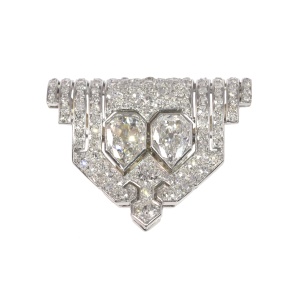
Iced out jewellery intersects with adjacent categories, including hip hop jewellery, luxury streetwear, contemporary high jewellery display, and watch culture. It can echo earlier all over diamond effects in historic jewellery, but the emphasis differs: dense coverage is treated as the primary design message, rather than a detail within an older style language. Its legacy is both visual and commercial, shaping expectations about scale, coverage, and the visibility of luxury in the early twenty first century.
The “iced out” aesthetic has influenced wider jewellery and watch design by normalising full surface stone coverage as a mainstream luxury signal. It also aligns with personal branding, where jewellery functions as a recognisable signature as well as a portable asset. Over time, particular object types, setting styles, and cultural references may become period markers for collectors, even when underlying techniques remain consistent.
9. Purpose of This Page
This page provides an overview of iced out jewellery within the context of jewellery history and design. It focuses on what is most relevant from a jewellery perspective and does not aim to be a full encyclopaedia of iced out jewellery. Instead, it offers a concise and structured introduction that highlights key interpretive angles and points towards deeper study.
This page is part of the Adin Jewellery Glossary and is also included in the Adin Styles Overview, where each style is presented with curated reference fields for browsing and comparison. Use and sharing for educational purposes are welcomed. If you reference or quote this page, please mention Adin as your source.
10. Accuracy Note
Interpretations and attributions can change as new research appears and as additional objects are published. If you notice an error, or if you can strengthen a statement with better documentation, Adin welcomes corrections and improvements.
11. Author Attribution
Elkan Wijnberg, Jewellery Historian and Antique Jewellery Specialist – Adin – www.antiquejewel.com.