
1. Introduction
Scope
Indian Revival in Western jewellery describes Western made jewels of the late nineteenth and early twentieth century that reinterpret Indian court forms, materials and colour harmonies, especially those associated with Mughal and princely jewellery. This term refers to Western made pieces that interpret Indian sources rather than jewellery produced in India. It sits within a wider taste for historic and exotic sources, but its references are recognisably Indian rather than a loosely Oriental mix.
From the later Victorian period onwards, these jewels became visible in Britain and on the Continent, appearing in court circles and fashionable society. In the early twentieth century, the strand was sustained by commissions for Indian patrons and by the resetting of stones from Indian regalia into European mounts, making it a distinct current within Western luxury design.
2. Cultural and Historical Influences
The Indian Revival in Western jewellery grew from intensified contact between Europe and the Indian subcontinent in the nineteenth century. The establishment of the British Raj after 1858, diplomatic exchanges with Indian rulers, and the circulation of jewels and regalia at world exhibitions made Mughal and princely ornaments more familiar to European audiences.
Travel writing, photographs and court portraits promoted an image of India as a place of dazzling colour and gem rich splendour. After Queen Victoria received the title Empress of India in 1876, the association with imperial prestige strengthened the appeal of Indian inspired jewels. In the early twentieth century, commissions from maharajas and the reworking of their gemstones by Parisian and London firms further reinforced this cross cultural exchange.
3. Visual Characteristics and Materials
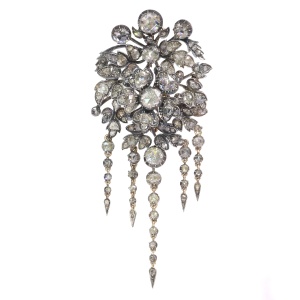
Indian Revival pieces combine Western goldsmithing and stone setting with elements borrowed from Indian court jewellery. Mounts typically follow European practice, with open settings in gold or platinum and precisely cut stones, yet they incorporate carved gemstones, bead clusters, pendant drops and fringe elements reminiscent of Indian necklaces and turban ornaments.
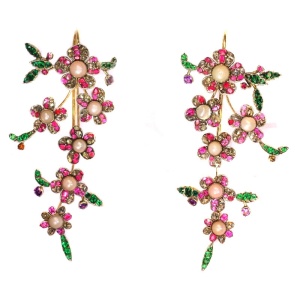
Designers favoured rich polychromy, often combining emeralds, rubies, sapphires and diamonds in dense arrangements that recall Mughal ornament. Carved stones, bead fringes and articulated links create an impression of continuous surface decoration and saturated colour, even though the construction is usually open and European rather than traditional close back kundan settings.
Motifs such as lotus flowers, mango or paisley shapes, and stylised buds and creepers appear as repeating friezes, panels or articulated chains, frequently paired with foliate scrollwork.
4. Function and Meaning
For Western wearers, Indian Revival jewellery could signal an interest in distant cultures and an association with the glamour of empire. Its colour intensity and abundance of gemstones suggested royal splendour, while recognisable motifs helped place the jewel within an imagined vision of India shaped by exhibitions, travel and court ceremonial.
These pieces could also express admiration for Indian gemstone carving, even when recast within a European aesthetic. At the same time it is important to remember that perhaps most jewels in the Indian Revival in Western jewellery style were created and worn simply because their materials, colours or forms appealed, without any further intention than beauty and attraction. The style therefore reflects both unequal power relations and genuine fascination, translated into wearable form.
5. Notable Creators and Exemplary Pieces
Major houses such as Cartier and Boucheron, together with leading London firms, played an important role in defining Indian Revival in Western jewellery. They acquired or were entrusted with princely stones, including carved emeralds and rubies, and reset them in compositions that retained a Mughal character while conforming to current Western taste.
Smaller workshops across Britain, France and other European centres echoed the trend in necklaces, brooches and bracelets that combined Western mounts with recognisably Indian inspired ornament, showing varied interpretations of the same dialogue between Indian forms and European fashion.
6. Recognition in Practice
Recognition rests on the meeting of Western construction and an Indian visual vocabulary: open set mounts in gold or platinum combined with carved stones, bead clusters, fringes and articulated drops. Colour often depends on strong contrasts of green, red and white, sometimes enriched with enamel or additional coloured stones. The overall effect is typically more saturated than comparable Victorian or Edwardian jewels, with silhouettes and surface density that recall Indian court ornaments.
7. Legacy and Related Styles
Related styles
The Indian Revival in Western jewellery belongs to the wider family of nineteenth century revival styles that also drew on Gothic, Renaissance and archaeological sources, but it is distinguished by its focus on an ongoing court tradition outside Europe. It developed alongside parallel exchanges in the other direction, where some Indian jewellers and workshops adopted Western style gem cutting and open settings, particularly from the late nineteenth century onwards, under British and wider international influence.
Legacy and later influence
The language of carved emeralds, ruby beads and Mughal inspired foliate forms informed early twentieth century creations and later interpretations of Indian inspired glamour. Cartier in particular developed suites of jewels with carved gemstones and foliate motifs that drew on Indian sources and commissions for maharajas, feeding into the Indian style jewels of the 1920s and 1930s now widely known as Tutti Frutti, a nickname applied from the 1970s.
Contemporary designers and heritage houses continue to revisit this dialogue between India and the West, showing the lasting impact of Indian Revival in Western jewellery on the imagination of jewellers and collectors.
8. Purpose of This Page
This page offers an overview of the historical Indian Revival in Western jewellery style within the context of jewellery history and design. It focuses on what is relevant from the perspective of the jewellery world and does not aim to be a full encyclopaedia on the Indian Revival in Western jewellery style. Instead, it strives to offer a concise and structured introduction that outlines key interpretive angles and points towards deeper study. This page is part of the Adin Glossary, a curated resource that brings documented historical knowledge into an ordered and accessible structure. Use and sharing for educational purposes are welcomed, and readers who reference or quote this page are kindly asked to mention Adin as their source.
9. Accuracy Note
Every effort has been made to present this information accurately and in line with current historical understanding. Interpretations may evolve as new research becomes available, and readers who notice points for refinement are welcome to share their insights.
10. Author Attribution
Elkan Wijnberg, Jewellery Historian and Antique Jewellery Specialist – Adin – www.antiquejewel.com