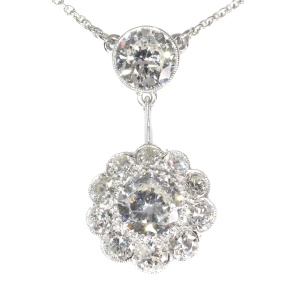

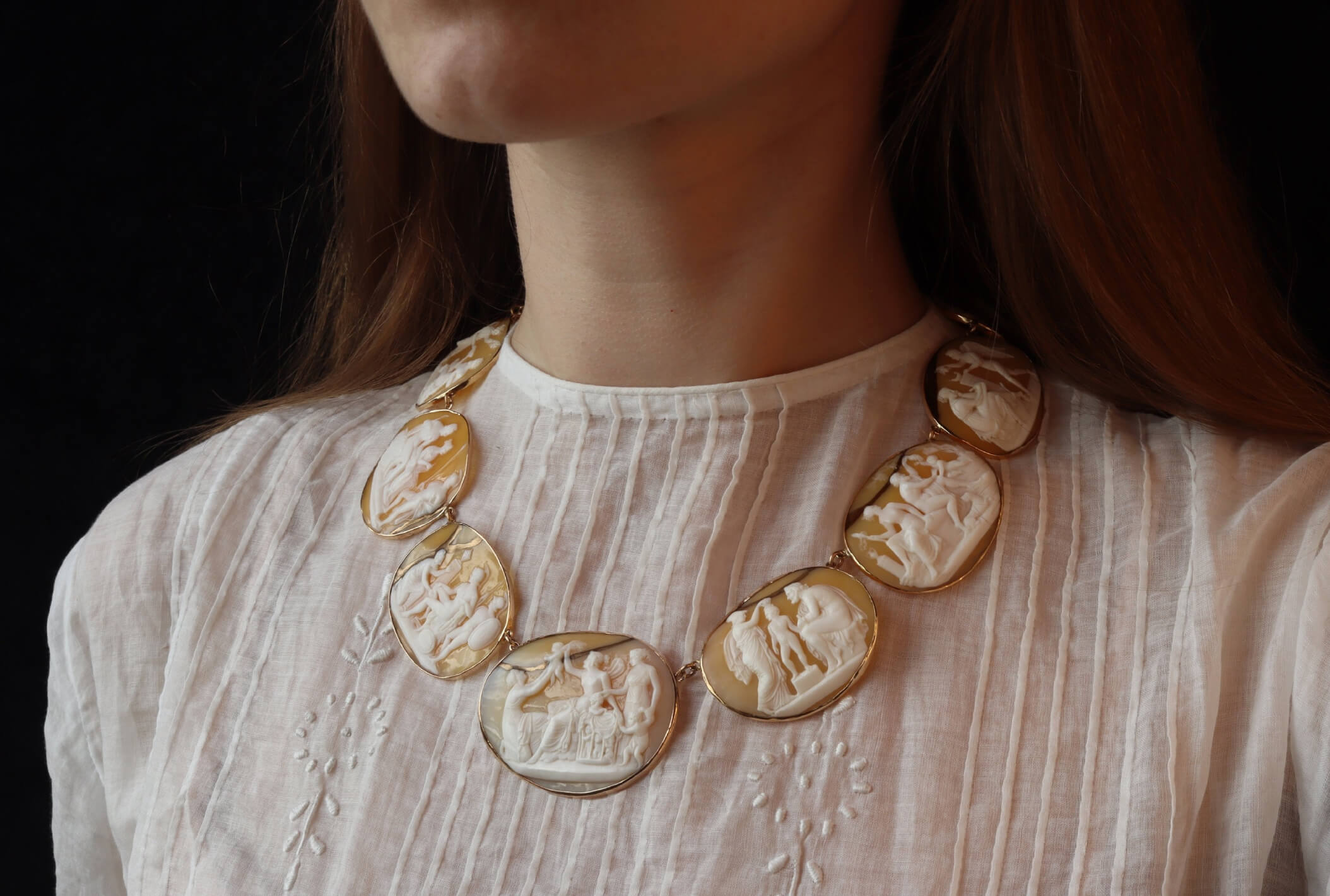
See our: ivory jewelry.A hard, creamy-white, opaque dentine that forms the tusks of elephants and some other mammals. It is translucent when cut in thin sheets. It is initially white but ages with a yellow to brownishpatina, and is marked with delicate horizontal graining. Different ivories show different colours under ultraviolet light.It has long been used for making jewelry in the form of finger rings, brooches, beads, bangles, netsuke, fans, etc., either smooth and polished or intricately carved, and also in inlay designs set ingold and jet, and as the base for miniature paintings. Ivory can be readily carved and has been used from earliest times in China and Japan for highly carved ornaments, plaques, and jewelry.It has been used from antiquity, and in the West especially from the 13th century, particularly in the Victorian era. During the 19th century the centre for European ivory carving was Dieppe, France,until c. 1870. Ivory carving was established in the late 19th century at Erbach, Germany, and the Erbach School, which still flourishes, is known for its ivory jewelry, especially the 'Erbach rose'that was copied from the 'Dieppe rose'.Ivory carving, using mainly walrus ivory and mammoth ivory, has been done in Russia since the 10th century, mainly making pieces with pierced designs; but the ware is principally object of verturather than jewelry. The use of ivory was revived by René Lalique and Wolfers for use in art nouveau jewelry. The largest piece of carved ivory come from Benin and Zaire. Ivory can be dyed, and it iscoloured with bright colours in Tibet.Imitation ivory ware is made from the seed of a South American and an African palm; it is known as vegetable ivory. Ivory is imitated in celluloid, made of comparable weight and colour as well as withartificial graining, but is distinguishable by being softer and more sectile. Real ivory will split or warp in extremes of temperature. The term 'ivory' without qualification refers to elephant ivory.
Ivory
Ivory
See our: ivory jewelry.A hard, creamy-white, opaque dentine that forms the tusks of elephants and some other mammals. It is translucent when cut in thin sheets. It is initially white but ages with a yellow to brownishpatina, and is marked with delicate horizontal graining. Different ivories show different colours under ultraviolet light.It has long been used for making jewelry in the form of finger rings, brooches, beads, bangles, netsuke, fans, etc., either smooth and polished or intricately carved, and also in inlay designs set ingold and jet, and as the base for miniature paintings. Ivory can be readily carved and has been used from earliest times in China and Japan for highly carved ornaments, plaques, and jewelry.It has been used from antiquity, and in the West especially from the 13th century, particularly in the Victorian era. During the 19th century the centre for European ivory carving was Dieppe, France,until c. 1870. Ivory carving was established in the late 19th century at Erbach, Germany, and the Erbach School, which still flourishes, is known for its ivory jewelry, especially the 'Erbach rose'that was copied from the 'Dieppe rose'.Ivory carving, using mainly walrus ivory and mammoth ivory, has been done in Russia since the 10th century, mainly making pieces with pierced designs; but the ware is principally object of verturather than jewelry. The use of ivory was revived by René Lalique and Wolfers for use in art nouveau jewelry. The largest piece of carved ivory come from Benin and Zaire. Ivory can be dyed, and it iscoloured with bright colours in Tibet.Imitation ivory ware is made from the seed of a South American and an African palm; it is known as vegetable ivory. Ivory is imitated in celluloid, made of comparable weight and colour as well as withartificial graining, but is distinguishable by being softer and more sectile. Real ivory will split or warp in extremes of temperature. The term 'ivory' without qualification refers to elephant ivory.
References
From: An Illustrated Dictionary of Jewelry, autor: Harold Newman, publishers: Thames and Hudson
%20and%20Pearl%20Gold%20Necklace-en.jpg)