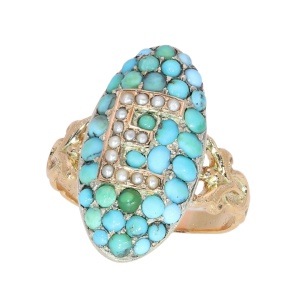

See our: memorial rings.A type of finger ring that was worn in memory of a deceased person. Originally in the Middle Ages rings of the deceased were given to and worn by relatives and friends, but when these provedinsufficient in number or the values of owned rings varied too much, the custom developed from the 15th to the 17th centuries of providing in a will that a number of identical and relativelyinexpensive rings (with the price sometimes stipulated) be made and donated to mourners.Many of such rings were of the Memento Mori style, but in the 17th and 18th centuries special forms were developed. Some had the interior of the hoopengraved with the name and dates of the deceased and the exterior enamelled in black to depict a skeleton or a foliage pattern.Other examples had the dates of the birth and death of the deceased inscribed on the outside of the shank (the latter date did not necessarily indicate the date of the making of the ring, as sometimessuch dates were added to rings formerly belonging to the deceased).The bezel of some mourning rings was set with a crystal over the initials of the deceased made in gold thread over a ground of silk or hair.After c. 1770 a lock of hair, a portrait or an enamelled mourning motif (an urn, weeping willow or broken column) was set under a crystal in the bezel. Some such rings were made in marquise shape,decorated with seed pearls, and were given by the male mourners to their wives to be generally worn. In the early 19th century some such rings were set with small gemstones, or black or violetenamelling was added to a gem-set ring owned by the deceased.In the late 19th century mourning rings ceased to be worn by the upper classes, but continued to be mass-produced, some set with jet or with a photograph in the bezel.
Mourning Or Memorial Ring
Mourning Or Memorial Ring
See our: memorial rings.A type of finger ring that was worn in memory of a deceased person. Originally in the Middle Ages rings of the deceased were given to and worn by relatives and friends, but when these provedinsufficient in number or the values of owned rings varied too much, the custom developed from the 15th to the 17th centuries of providing in a will that a number of identical and relativelyinexpensive rings (with the price sometimes stipulated) be made and donated to mourners.Many of such rings were of the Memento Mori style, but in the 17th and 18th centuries special forms were developed. Some had the interior of the hoopengraved with the name and dates of the deceased and the exterior enamelled in black to depict a skeleton or a foliage pattern.Other examples had the dates of the birth and death of the deceased inscribed on the outside of the shank (the latter date did not necessarily indicate the date of the making of the ring, as sometimessuch dates were added to rings formerly belonging to the deceased).The bezel of some mourning rings was set with a crystal over the initials of the deceased made in gold thread over a ground of silk or hair.After c. 1770 a lock of hair, a portrait or an enamelled mourning motif (an urn, weeping willow or broken column) was set under a crystal in the bezel. Some such rings were made in marquise shape,decorated with seed pearls, and were given by the male mourners to their wives to be generally worn. In the early 19th century some such rings were set with small gemstones, or black or violetenamelling was added to a gem-set ring owned by the deceased.In the late 19th century mourning rings ceased to be worn by the upper classes, but continued to be mass-produced, some set with jet or with a photograph in the bezel.
References
From: An Illustrated Dictionary of Jewelry, autor: Harold Newman, publishers: Thames and Hudson