
Adin Glossary: Styles and periods

Neoclassical jewellery

circa 1760 to 1830, polished gold frames cameos, intaglios and micromosaics

1. Introduction

Neoclassical jewellery emerged in the later eighteenth century as a reaction against Rococo asymmetry, reviving the ordered forms and motifs of classical antiquity. It drew inspiration from archaeological discoveries at Pompeii and Herculaneum, and from Enlightenment ideals that valued clarity, proportion and restraint.

In its later phase, fascination with Egypt, especially following Napoleon’s Egyptian campaign, broadened the repertoire with motifs such as the sphinx, the lotus and the solar disc, while the overall design language remained disciplined and balanced.


2. Cultural and Historical Influences

Neoclassicism developed in the later eighteenth century as part of a wider cultural movement that sought to revive the virtues of antiquity. The excavations of Herculaneum in 1738 and Pompeii in 1748 revealed the ancient world and influenced artists, architects and jewellers alike. An Enlightenment emphasis on reason, science and order encouraged an aesthetic that valued clarity and restraint over Rococo caprice.

Across Europe, academies promoted the study of classical art, while travellers on the Grand Tour brought home ancient gems and cameos that renewed admiration for antiquity. In France, Neoclassical taste was championed under Louis XVI and later at Napoleon’s court, whose Egyptian campaign introduced motifs such as the sphinx, the lotus and the solar disc, extending the classical vocabulary.


3. Visual Characteristics and Materials

Neoclassical jewellery favours symmetry, clear profiles and balanced compositions, drawing on Greek and Roman motifs such as laurel wreaths, garlands, urns, lyres, torches, portrait heads and architectural borders. The emphasis is on proportion rather than surface excess.

Gold settings are often plain and polished, sometimes paired with white enamel to suggest marble-like clarity. Hardstone cameos and intaglios, glass paste versions, and micro mosaics are central elements, valued both for craftsmanship and for their antiquarian reference.

Delicate techniques such as filigree, cannetille, fine beaded wirework or granulated effects and wirework create lightness without ornament for its own sake. Other refinements may include micro mosaic inlay, verre églomisé, foil-backed settings and miniature paintings on ivory. Pearls and white paste stones provide restrained highlights, with stronger colour used sparingly.


4. Function and Meaning

Neoclassical jewellery expressed ideals of virtue, intellect and timeless beauty by translating antique imagery into personal adornment. Classical figures, laurel wreaths and urns could symbolise wisdom, loyalty and remembrance, while portrait cameos evoked the dignity of ancient rulers and philosophers.

Many jewels carried sentimental or memorial significance, with inscriptions, miniature urns and hairwork. Hair could be woven into plaits or curls and placed beneath crystal panels, preserving a tangible link between affection and memory, aligning with the period’s preference for measured emotion. At the same time it is important to remember that perhaps most Neoclassical jewels were created and worn simply because their materials, colours or forms appealed, without any further intention than beauty and attraction.


5. Notable Creators and Exemplary Pieces

Neoclassical taste spread through designers and manufacturers across Europe. In Britain, Josiah Wedgwood produced jasperware medallions with white reliefs on blue grounds, often mounted as cameos in gold or pinchbeck. James Tassie supplied engraved glass pastes and portrait intaglios that imitated ancient stones, while Matthew Boulton’s Soho Manufactory produced mounts and ornaments that helped disseminate Neoclassical taste, and London workshops such as Rundell, Bridge and Rundell, and John Linnit, refined classical forms into high quality jewels for elite patrons.
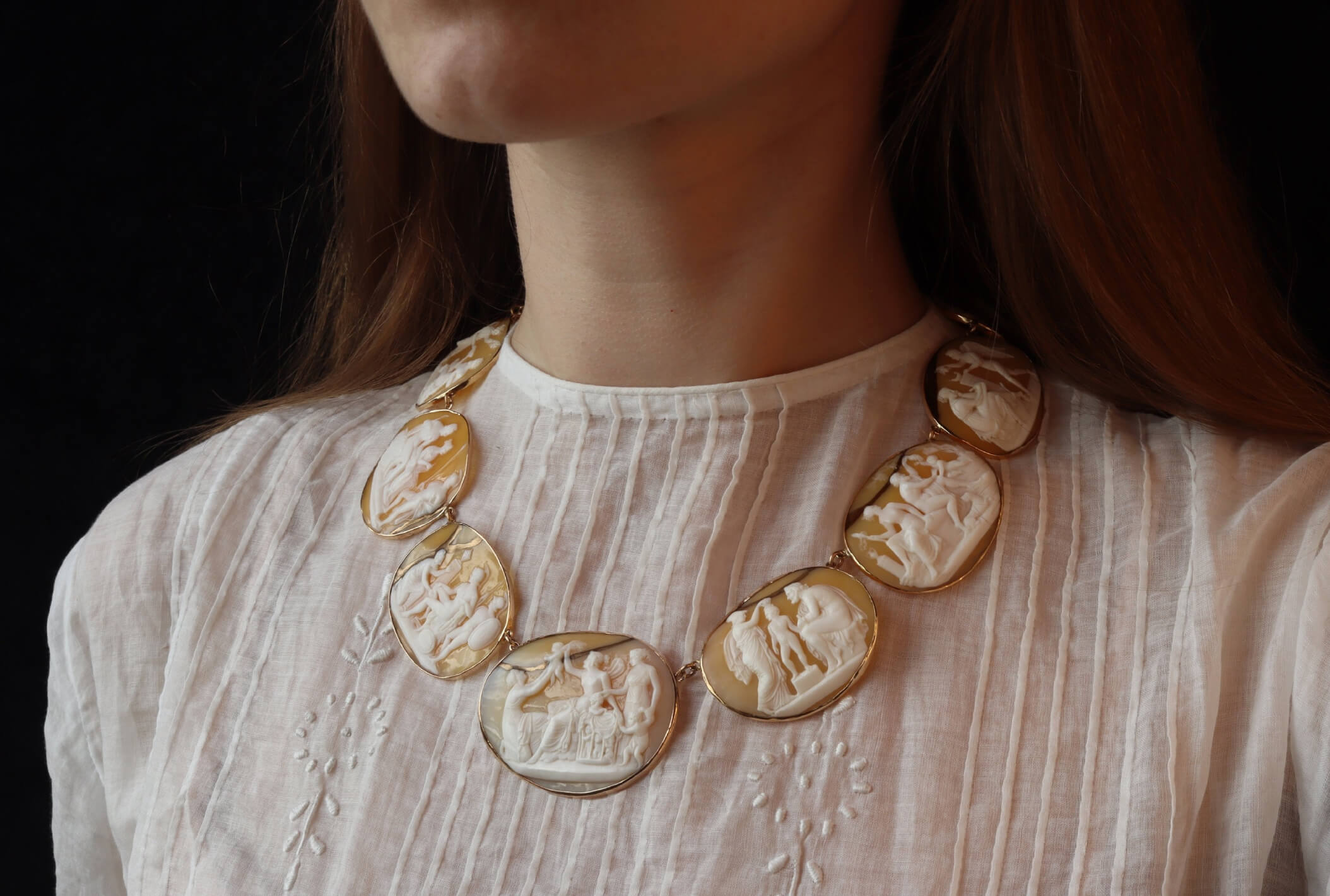
In France, jewellers under Louis XVI created parures combining cameos, pearls and enamelled gold, later adapted for the Napoleonic court. Italian centres such as Rome, Naples and Milan specialised in hardstone carving and micro mosaics for Grand Tour travellers, and craftsmen in centres such as Geneva produced fine enamel miniatures, and hairwork medallions were made widely across Britain and the Continent. Typical Neoclassical jewels include cameo necklaces, memorial rings, miniature portrait brooches and oval lockets framed by laurel wreaths.


6. Recognition in Practice

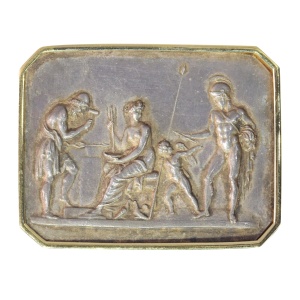
Neoclassical jewellery is recognisable by symmetry, clear outlines and classical framing motifs. Look for oval or rectangular forms with laurel wreaths, urns, lyres, torches or profile cameos, set in plain polished gold, sometimes highlighted with white enamel, seed pearls or fine cannetille work, particularly common in the 1820s. Hardstone cameos and intaglios, glass paste and subjects from Greek and Roman mythology are frequent. Micro mosaics depicting ancient monuments or mythological scenes appear, especially in jewels associated with Grand Tour collecting. Memorial pieces may include hair arranged beneath crystal, bordered by enamel or pearls, and the overall palette tends towards subdued golds, whites and soft blues.


7. Related Styles and Legacy

Neoclassicism bridged Rococo exuberance and the imperial grandeur of the Empire style. Compared with Rococo, Neoclassical jewels feel restrained and architectural, and compared with the later Empire style, they are usually lighter and more personal in scale. The style reintroduced order, symmetry and moral seriousness into the visual language of late eighteenth and early nineteenth century Europe.
Fascination with antiquity continued into the Empire period under Napoleon, where classical motifs became more monumental and martial, and later revivals in the nineteenth century looked again to classical sources, particularly during the Victorian era. In the nineteenth century, especially in the United States, periodicals such as Godey’s Lady’s Book (founded 1830) and manuals such as Mark Campbell’s Self Instructor in the Art of Hair Work (1867) circulated hairwork techniques and designs. Neoclassical jewels remain admired for their disciplined harmony and the balance of intellect and beauty expressed through form.


8. Purpose of This Page

This page offers an overview of the historical Neoclassical jewellery style within the context of jewellery history and design. It focuses on what is relevant from the perspective of the jewellery world and does not aim to be a full encyclopaedia on the Neoclassical jewellery style. Instead, it strives to offer a concise and structured introduction that outlines key interpretive angles and points towards deeper study. This page is part of the Adin Glossary, a curated resource that brings documented historical knowledge into an ordered and accessible structure. Use and sharing for educational purposes are welcomed, and readers who reference or quote this page are kindly asked to mention Adin as their source.


9. Accuracy Note

Every effort has been made to present this information accurately and in line with current historical understanding. Interpretations may evolve as new research becomes available, and readers who notice points for refinement are welcome to share their insights.


10. Author Attribution

Elkan Wijnberg, Jewellery Historian and Antique Jewellery Specialist – Adin – www.antiquejewel.com
Neoclassical jewellery revives classical antiquity through clear profiles, balanced compositions, cameos and intaglios, expressing late eighteenth cen

circa 1760 to 1830

archaeological discoveries at Herculaneum and Pompeii, Enlightenment ideals of reason, science and order, study of Greek and Roman art, Grand Tour collecting and antiquarian taste, French court under Louis XVI, Napoleonic era and the Egyptian campaign, academic teaching of classical art, taste for sentimental and memorial jewellery

France, United Kingdom, Italy

laurel wreaths and classical garlands, urns and funerary vessels, lyres, torches and antique trophies, classical profiles and portrait heads, Greek and Roman mythological figures, architectural borders and friezes, micro mosaic views of ancient monuments, Egyptian-inspired motifs such as the sphinx, the lotus and the solar disc, memorial urns and weeping willows, hairwork panels beneath crystal framed by pearls or enamel

yellow gold and occasionally pinchbeck, hardstone cameos and intaglios, glass paste cameos, micro mosaics, white enamel and enamel borders, pearls and white paste stones, rock crystal panels protecting hairwork, miniature paintings on ivory or enamel

fine cannetille (coiled wirework), particularly popular in the 1820s, and filigree (fine twisted wire openwork), granulated effects (tiny applied beaded details) and wirework, mounting of cameos and intaglios (engraved gems) in plain polished gold, micro mosaic inlay, verre églomisé (reverse gilded glass), occasionally used, foil-backed settings, hairwork arranged beneath crystal, enamel borders in white or restrained colours

Greek, Greco-Roman, Classical Jewellery, Directoire, Empire, Archaeological Revival, British Regency, Restoration

Classical & Antiquarian Classicism (ancient formal language as the core)

Adin Academy

Neoclassical jewellery

No items found.

1. Introduction

Neoclassical jewellery emerged in the later eighteenth century as a reaction against Rococo asymmetry, reviving the ordered forms and motifs of classical antiquity. It drew inspiration from archaeological discoveries at Pompeii and Herculaneum, and from Enlightenment ideals that valued clarity, proportion and restraint.

In its later phase, fascination with Egypt, especially following Napoleon’s Egyptian campaign, broadened the repertoire with motifs such as the sphinx, the lotus and the solar disc, while the overall design language remained disciplined and balanced.


2. Cultural and Historical Influences

Neoclassicism developed in the later eighteenth century as part of a wider cultural movement that sought to revive the virtues of antiquity. The excavations of Herculaneum in 1738 and Pompeii in 1748 revealed the ancient world and influenced artists, architects and jewellers alike. An Enlightenment emphasis on reason, science and order encouraged an aesthetic that valued clarity and restraint over Rococo caprice.

Across Europe, academies promoted the study of classical art, while travellers on the Grand Tour brought home ancient gems and cameos that renewed admiration for antiquity. In France, Neoclassical taste was championed under Louis XVI and later at Napoleon’s court, whose Egyptian campaign introduced motifs such as the sphinx, the lotus and the solar disc, extending the classical vocabulary.


3. Visual Characteristics and Materials

Neoclassical jewellery favours symmetry, clear profiles and balanced compositions, drawing on Greek and Roman motifs such as laurel wreaths, garlands, urns, lyres, torches, portrait heads and architectural borders. The emphasis is on proportion rather than surface excess.

Gold settings are often plain and polished, sometimes paired with white enamel to suggest marble-like clarity. Hardstone cameos and intaglios, glass paste versions, and micro mosaics are central elements, valued both for craftsmanship and for their antiquarian reference.

Delicate techniques such as filigree, cannetille, fine beaded wirework or granulated effects and wirework create lightness without ornament for its own sake. Other refinements may include micro mosaic inlay, verre églomisé, foil-backed settings and miniature paintings on ivory. Pearls and white paste stones provide restrained highlights, with stronger colour used sparingly.


4. Function and Meaning

Neoclassical jewellery expressed ideals of virtue, intellect and timeless beauty by translating antique imagery into personal adornment. Classical figures, laurel wreaths and urns could symbolise wisdom, loyalty and remembrance, while portrait cameos evoked the dignity of ancient rulers and philosophers.

Many jewels carried sentimental or memorial significance, with inscriptions, miniature urns and hairwork. Hair could be woven into plaits or curls and placed beneath crystal panels, preserving a tangible link between affection and memory, aligning with the period’s preference for measured emotion. At the same time it is important to remember that perhaps most Neoclassical jewels were created and worn simply because their materials, colours or forms appealed, without any further intention than beauty and attraction.


5. Notable Creators and Exemplary Pieces

Neoclassical taste spread through designers and manufacturers across Europe. In Britain, Josiah Wedgwood produced jasperware medallions with white reliefs on blue grounds, often mounted as cameos in gold or pinchbeck. James Tassie supplied engraved glass pastes and portrait intaglios that imitated ancient stones, while Matthew Boulton’s Soho Manufactory produced mounts and ornaments that helped disseminate Neoclassical taste, and London workshops such as Rundell, Bridge and Rundell, and John Linnit, refined classical forms into high quality jewels for elite patrons.
In France, jewellers under Louis XVI created parures combining cameos, pearls and enamelled gold, later adapted for the Napoleonic court. Italian centres such as Rome, Naples and Milan specialised in hardstone carving and micro mosaics for Grand Tour travellers, and craftsmen in centres such as Geneva produced fine enamel miniatures, and hairwork medallions were made widely across Britain and the Continent. Typical Neoclassical jewels include cameo necklaces, memorial rings, miniature portrait brooches and oval lockets framed by laurel wreaths.


6. Recognition in Practice

Neoclassical jewellery is recognisable by symmetry, clear outlines and classical framing motifs. Look for oval or rectangular forms with laurel wreaths, urns, lyres, torches or profile cameos, set in plain polished gold, sometimes highlighted with white enamel, seed pearls or fine cannetille work, particularly common in the 1820s. Hardstone cameos and intaglios, glass paste and subjects from Greek and Roman mythology are frequent. Micro mosaics depicting ancient monuments or mythological scenes appear, especially in jewels associated with Grand Tour collecting. Memorial pieces may include hair arranged beneath crystal, bordered by enamel or pearls, and the overall palette tends towards subdued golds, whites and soft blues.


7. Related Styles and Legacy

Neoclassicism bridged Rococo exuberance and the imperial grandeur of the Empire style. Compared with Rococo, Neoclassical jewels feel restrained and architectural, and compared with the later Empire style, they are usually lighter and more personal in scale. The style reintroduced order, symmetry and moral seriousness into the visual language of late eighteenth and early nineteenth century Europe.
Fascination with antiquity continued into the Empire period under Napoleon, where classical motifs became more monumental and martial, and later revivals in the nineteenth century looked again to classical sources, particularly during the Victorian era. In the nineteenth century, especially in the United States, periodicals such as Godey’s Lady’s Book (founded 1830) and manuals such as Mark Campbell’s Self Instructor in the Art of Hair Work (1867) circulated hairwork techniques and designs. Neoclassical jewels remain admired for their disciplined harmony and the balance of intellect and beauty expressed through form.


8. Purpose of This Page

This page offers an overview of the historical Neoclassical jewellery style within the context of jewellery history and design. It focuses on what is relevant from the perspective of the jewellery world and does not aim to be a full encyclopaedia on the Neoclassical jewellery style. Instead, it strives to offer a concise and structured introduction that outlines key interpretive angles and points towards deeper study. This page is part of the Adin Glossary, a curated resource that brings documented historical knowledge into an ordered and accessible structure. Use and sharing for educational purposes are welcomed, and readers who reference or quote this page are kindly asked to mention Adin as their source.


9. Accuracy Note

Every effort has been made to present this information accurately and in line with current historical understanding. Interpretations may evolve as new research becomes available, and readers who notice points for refinement are welcome to share their insights.


10. Author Attribution

Elkan Wijnberg, Jewellery Historian and Antique Jewellery Specialist – Adin – www.antiquejewel.com
Also known as:

References