
An inlay used in decorating in black on silver (infrequently on gold) that is somewhat related to champlevi work except that the effect is metallic rather than vitreous.The process involved engraving (or, for large areas, using other indenting processes) the design into a metal plate, then filling the indented portions with a powdered black matt alloy made ofmetallic sulphides (sulphur with silver, copper, and lead) according to various formulae, together with a flux, after which the piece was heated until the alloy melted (at 12000 C) and became fused inthe grooves and depressions of the design; the piece, when cooled, was scraped and polished until the niello was removed except in the then contrasting design.Niello decoration is found on Bronze Ages non-jewelry articles (usually of gold) and was reintroduced in Roman jewelry in the 4th century AD, and was also used in Egyptian and early Byzantine jewelry,as well as Anglo-Saxon jewelry; however, the method for executing such work was different, in that the inlay was of silver sulphide alone, and it was not melted but merely heated until plastic, theninlayed and burnished. In the 11th century the niello formulae were developed, and it was used on gothic jewelry and on some pieces made during the Renaissance.Niello has been used also in India and Islamic countries, and also in Russia. An imitative process was used in the Balkans by inlaying lead alone, and also by Dutch engravers during the late 16th andmid-17th centuries by applying niello as a background. Its use was revived in the 19th century by Karl Wagner; and it was used in France by Imile Froment-Meurice and in London by S.H. and D. Gass.In recent years it has been simulated by painting on the surface with a niello preparation as a background or a design. Some niello work is being done today in the Far East. The German term isSchwarzornamente.
Niello
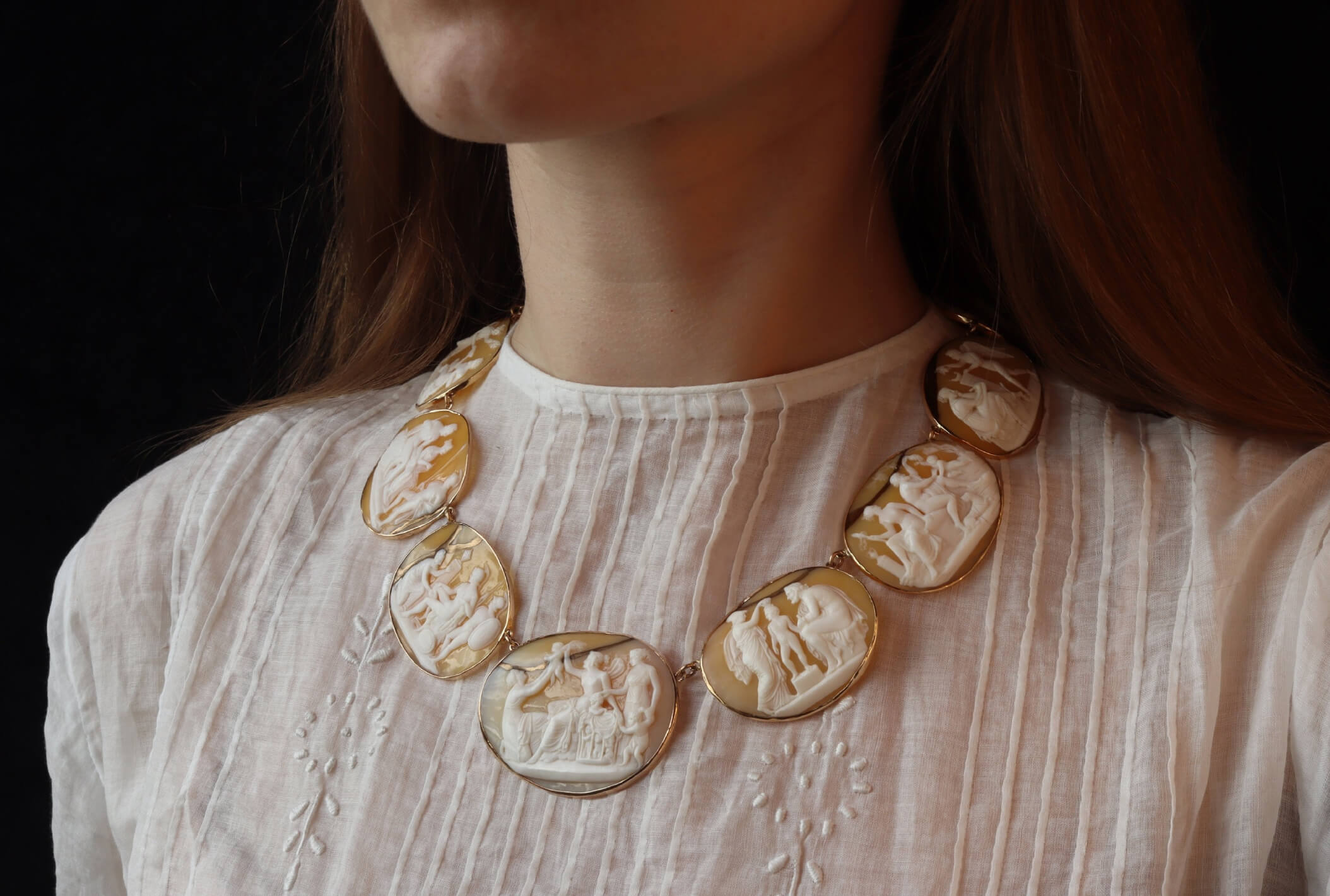
Niello
An inlay used in decorating in black on silver (infrequently on gold) that is somewhat related to champlevi work except that the effect is metallic rather than vitreous.The process involved engraving (or, for large areas, using other indenting processes) the design into a metal plate, then filling the indented portions with a powdered black matt alloy made ofmetallic sulphides (sulphur with silver, copper, and lead) according to various formulae, together with a flux, after which the piece was heated until the alloy melted (at 12000 C) and became fused inthe grooves and depressions of the design; the piece, when cooled, was scraped and polished until the niello was removed except in the then contrasting design.Niello decoration is found on Bronze Ages non-jewelry articles (usually of gold) and was reintroduced in Roman jewelry in the 4th century AD, and was also used in Egyptian and early Byzantine jewelry,as well as Anglo-Saxon jewelry; however, the method for executing such work was different, in that the inlay was of silver sulphide alone, and it was not melted but merely heated until plastic, theninlayed and burnished. In the 11th century the niello formulae were developed, and it was used on gothic jewelry and on some pieces made during the Renaissance.Niello has been used also in India and Islamic countries, and also in Russia. An imitative process was used in the Balkans by inlaying lead alone, and also by Dutch engravers during the late 16th andmid-17th centuries by applying niello as a background. Its use was revived in the 19th century by Karl Wagner; and it was used in France by Imile Froment-Meurice and in London by S.H. and D. Gass.In recent years it has been simulated by painting on the surface with a niello preparation as a background or a design. Some niello work is being done today in the Far East. The German term isSchwarzornamente.
References
From: An Illustrated Dictionary of Jewelry, autor: Harold Newman, publishers: Thames and Hudson