
1. Introduction
Orientalism and Japonisme in jewellery reflect the impact of non-European cultures on Western design from the mid nineteenth to the early twentieth century, as travel, trade and printed imagery made Asian and Middle Eastern art more widely known. On this page, Orientalism is used as a historical and art historical term for Western responses to Asian and Middle Eastern art, often filtered through Western interpretation.
Rather than copying foreign models, jewellers reinterpreted Islamic ornament, Indian craftsmanship and Japanese compositional principles such as asymmetry, negative space, flattened perspective and simplified natural forms. These approaches broadened the Western jewellery vocabulary and fed into late Victorian eclecticism, Arts and Crafts design and Art Nouveau.
2. Cultural and Historical Influences
Orientalism and Japonisme grew from expanding global connections during the nineteenth century. Trade with India and the Middle East brought textiles, metalwork and enamelled objects that influenced Western designers. European colonial presence in Asia also brought materials and techniques, though they were often filtered through Western taste.
The opening of Japan to the West from 1853 onwards was especially transformative. Japanese prints, ceramics and metalwork entered European markets in large numbers, and international exhibitions in London, Paris and Vienna presented objects from across Asia to a wide audience.
Alongside access to objects, interest in comparative art and world cultures encouraged designers to treat non-Western aesthetics as sources of innovation. Jewellers in France, Britain, Austria and the United States adopted these influences to varying degrees, integrating them into Arts and Crafts and Art Nouveau work.
3. Visual Characteristics and Materials
Japonisme often favours asymmetrical, pictorial compositions, with curving branches, simplified floral forms and stylised birds or insects. Surfaces may combine fine linear detail with broad planes of enamel colour. Negative space becomes an active part of the design.
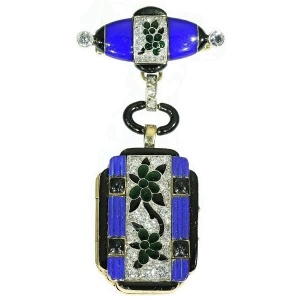
Orientalist influence appears through arabesques, horseshoe arches, palmettes, lotus flowers and repeating geometric patterns derived from Islamic art. Colour is typically saturated, with enamel in deep blues, greens and ruby tones. Metal surfaces may be patterned or textured. Indian inspired work may include kundan style settings, granulated ornament and detailed enamel reminiscent of North Indian traditions, especially Jaipur.
Materials vary widely, but commonly include warm toned gold or silver, enamel and coloured gemstones, with occasional glass, mother of pearl or carved ivory. Across these variations, the defining feature is an alternative compositional logic, where line and motif follow principles rooted in Asian and Middle Eastern art rather than European academic convention.
4. Function and Meaning
Meaning in Orientalist and Japoniste jewellery is often carried by motifs and their cultural associations rather than by personal or sentimental messages. Japonisme tends to evoke natural harmony, impermanence and refined simplicity, while Orientalist themes suggest richness and patterned abundance shaped by European imagination. Indian inspired designs are frequently framed around ideas of colour, craftsmanship and ceremonial splendour.
These meanings often reflect Western interpretation rather than authenticated cultural symbolism. At the same time it is important to remember that perhaps most Orientalism and Japonisme in jewellery jewels were created and worn simply because their materials, colours or forms appealed, without any further intention than beauty and attraction.
5. Notable Creators and Exemplary Pieces
Several leading jewellers drew on Orientalism and Japonisme. In France, Lucien Gaillard used enamel, horn and gold for fluid designs with stylised natural motifs. Henri Vever produced enamelled gold jewels, often set with gemstones. Georges Fouquet and the workshop of Maison Falize explored both Japanese and Middle Eastern influences, including cloisonné enamel and rhythmic ornament. In Britain, Liberty & Co helped disseminate Japanese inspired design through its Cymric and Tudric lines, while Arts and Crafts jewellers adapted Japanese principles to handwrought metal and naturalistic forms. In the United States, Louis Comfort Tiffany combined Islamic and Japanese elements in experimental enamel and glasswork. Typical pieces include enamelled pendants, asymmetrical brooches shaped as birds or insects, and bracelets enriched with ornament and saturated colour.
6. Recognition in Practice
These jewels are often recognisable by a departure from European symmetry and by motifs and compositions rooted in Asian art. Japonisme is typically signalled by asymmetry, flowing branches, simplified botanical forms and stylised animals. Negative space is used as a deliberate design element, and enamel is applied in flat or gently modelled colour fields.
Orientalist pieces commonly feature repeating geometric or foliate ornament arranged in rhythmic bands, enamel in deep blue, green or crimson tones, and gold surfaces worked with fine linear or granulated texture. Forms may appear lighter and more pictorial than those of many contemporary European styles.
7. Related Styles and Legacy
Orientalism and Japonisme played essential roles in the transition from nineteenth century historicism to modern artistic expression.
Related styles
Japonisme shaped Art Nouveau, especially its treatment of nature, asymmetry and enamel. Depending on the sources used, these jewels can appear either more restrained or more pattern led than Art Nouveau, and they differ from Historic Revival work in their non-European vocabulary and alternative approach to line, colour and composition. Orientalist motifs supported Victorian eclecticism and reappeared in early twentieth century designs seeking alternatives to geometric modernity. The same influences also aligned with Arts and Crafts ideals, particularly admiration for Japanese simplicity and unity of design and making.
Legacy
In the twentieth century, these influences resurfaced in forms, ranging from Art Deco abstraction to continued interest in Japanese metalwork among studio jewellers.
Today, jewels shaped by Orientalism and Japonisme are valued for expanding Western jewellery vocabulary and demonstrating the complexity of cross-cultural exchange.
8. Purpose of This Page
This page offers an overview of the historical Orientalism and Japonisme in jewellery style within the context of jewellery history and design. It focuses on what is relevant from the perspective of the jewellery world and does not aim to be a full encyclopaedia on the Orientalism and Japonisme in jewellery style. Instead, it strives to offer a concise and structured introduction that outlines key interpretive angles and points towards deeper study. This page is part of the Adin Glossary, a curated resource that brings documented historical knowledge into an ordered and accessible structure. Use and sharing for educational purposes are welcomed, and readers who reference or quote this page are kindly asked to mention Adin as their source.
9. Accuracy Note
Every effort has been made to present this information accurately and in line with current historical understanding. Interpretations may evolve as new research becomes available, and readers who notice points for refinement are welcome to share their insights.
10. Author Attribution
Elkan Wijnberg, Jewellery Historian and Antique Jewellery Specialist – Adin – www.antiquejewel.com