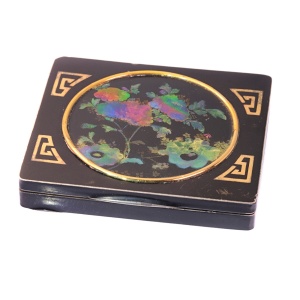

See our: painted jewelry.Enamel decoration on a flat surface with the enamel applied by painting with a brush, as in grisaille, without any cloisons or depressions in the metal base to separate the colours, such as incloisonné or champlevé enamelling. Several layers of enamel are applied, using different colours to make thedesign, each layer being fused and polished (first on a carborundum wheel and then by a felt buff charged with pumice) before the next layer is applied; the later layers must each have a lowermelting-point than the preceding layers to avoid mingling.This method was developed in the 15th century but was not successful until the introduction of counter-enamelling. It has become known as Limoges enamelowing to its having been used extensively at Limoges, although not exclusively there. A modern version sometimes uses a stencil to outline the design.
Painted Enamel
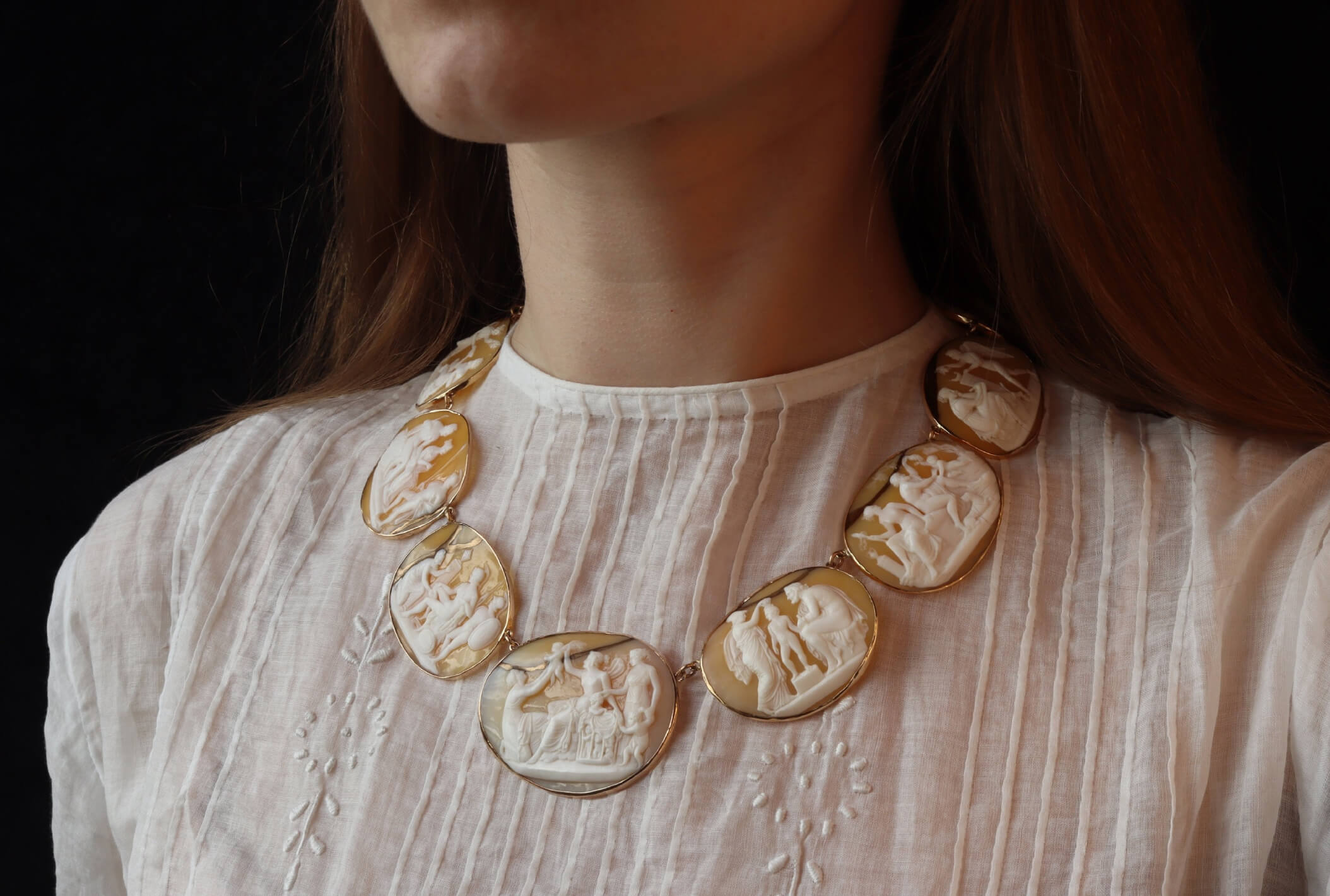
Painted Enamel
See our: painted jewelry.Enamel decoration on a flat surface with the enamel applied by painting with a brush, as in grisaille, without any cloisons or depressions in the metal base to separate the colours, such as incloisonné or champlevé enamelling. Several layers of enamel are applied, using different colours to make thedesign, each layer being fused and polished (first on a carborundum wheel and then by a felt buff charged with pumice) before the next layer is applied; the later layers must each have a lowermelting-point than the preceding layers to avoid mingling.This method was developed in the 15th century but was not successful until the introduction of counter-enamelling. It has become known as Limoges enamelowing to its having been used extensively at Limoges, although not exclusively there. A modern version sometimes uses a stencil to outline the design.
References
From: An Illustrated Dictionary of Jewelry, autor: Harold Newman, publishers: Thames and Hudson