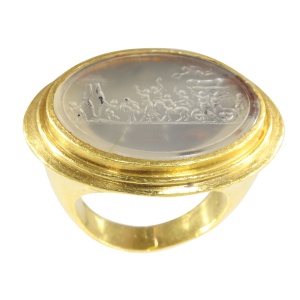

A type of finger ring that is engraved with a posy (a brief naïve sentimental expression, the word being contracted from 'poesy' or 'poetry'; before the 15th century, called a 'reson'). The amatoryinscription (often rhymed) was usually (and especially after the 16th century) hidden on the inside of the hoop, but sometimes was on the exterior, sometimes on both sides.The language of the inscription was usually Norman French, and the dating of the rings is generally determined by the script. Such inscriptions are also found on some signet rings. The rings wereusually, from the 17th century, an engagement ring or a wedding ring, but some of the inscriptions are ambiguous as to the use. Rings inscribed with a version of a posy were worn in classical times,but their use ceased during the Dark Ages until they were revived with the rise of chivalry in the age of feudalism. They were principally worn in England from the 14th century (a few are French)until they were mass-produced and went out of fashion in the 18th century.The engraving of sentimental inscriptions on the inside of a wedding ring has been somewhat revived in modern times.
Posy Ring
Posy Ring
A type of finger ring that is engraved with a posy (a brief naïve sentimental expression, the word being contracted from 'poesy' or 'poetry'; before the 15th century, called a 'reson'). The amatoryinscription (often rhymed) was usually (and especially after the 16th century) hidden on the inside of the hoop, but sometimes was on the exterior, sometimes on both sides.The language of the inscription was usually Norman French, and the dating of the rings is generally determined by the script. Such inscriptions are also found on some signet rings. The rings wereusually, from the 17th century, an engagement ring or a wedding ring, but some of the inscriptions are ambiguous as to the use. Rings inscribed with a version of a posy were worn in classical times,but their use ceased during the Dark Ages until they were revived with the rise of chivalry in the age of feudalism. They were principally worn in England from the 14th century (a few are French)until they were mass-produced and went out of fashion in the 18th century.The engraving of sentimental inscriptions on the inside of a wedding ring has been somewhat revived in modern times.
References
From: An Illustrated Dictionary of Jewelry, autor: Harold Newman, publishers: Thames and Hudson