
1. Introduction
Renaissance jewellery reflects the rebirth of art, learning and individuality that transformed Europe between the fifteenth and sixteenth centuries. Emerging in Italy in the late fourteenth and early fifteenth centuries, it embodied the ideals of humanism, celebrating the rediscovery of classical antiquity and the dignity of man. Goldsmiths, painters and sculptors worked side by side, sharing a renewed respect for proportion, symmetry and natural beauty, so that jewellery became not only a display of wealth but also a statement of intellect, taste and cultural refinement.
Powerful patrons such as the Medici in Florence, the Este in Ferrara and the Sforza in Milan supported artists who blended classical themes with Christian symbolism. The jeweller was no longer regarded as a mere craftsman but as an artist whose work could rival painting or sculpture in complexity and meaning. Portraits of the time show jewels as extensions of identity, expressing status, allegiance and sometimes secret devotion, while many goldsmiths mastered drawing, anatomy and architecture in order to refine their designs.
2. Historical and Cultural Context
The Renaissance is generally understood to have begun in Italy, where prosperity, scholarship and artistic ambition combined to create a new vision of the world. Cities such as Florence, Venice and Rome became centres of artistic innovation. Wealthy patrons commissioned jewels as tokens of devotion, power and taste, often designed by the same artists who painted their portraits or built their palaces, so that this close relationship between the arts gave jewellery an intellectual depth not seen in previous centuries.
At the same time, adornment was not simply a matter of taste or wealth. In many parts of Renaissance Europe, sumptuary laws sought to regulate the public display of luxury according to rank, circumstance or civic morality, which means that jewellery must also be understood within a culture in which splendour could be admired, expected and at times legally restrained.
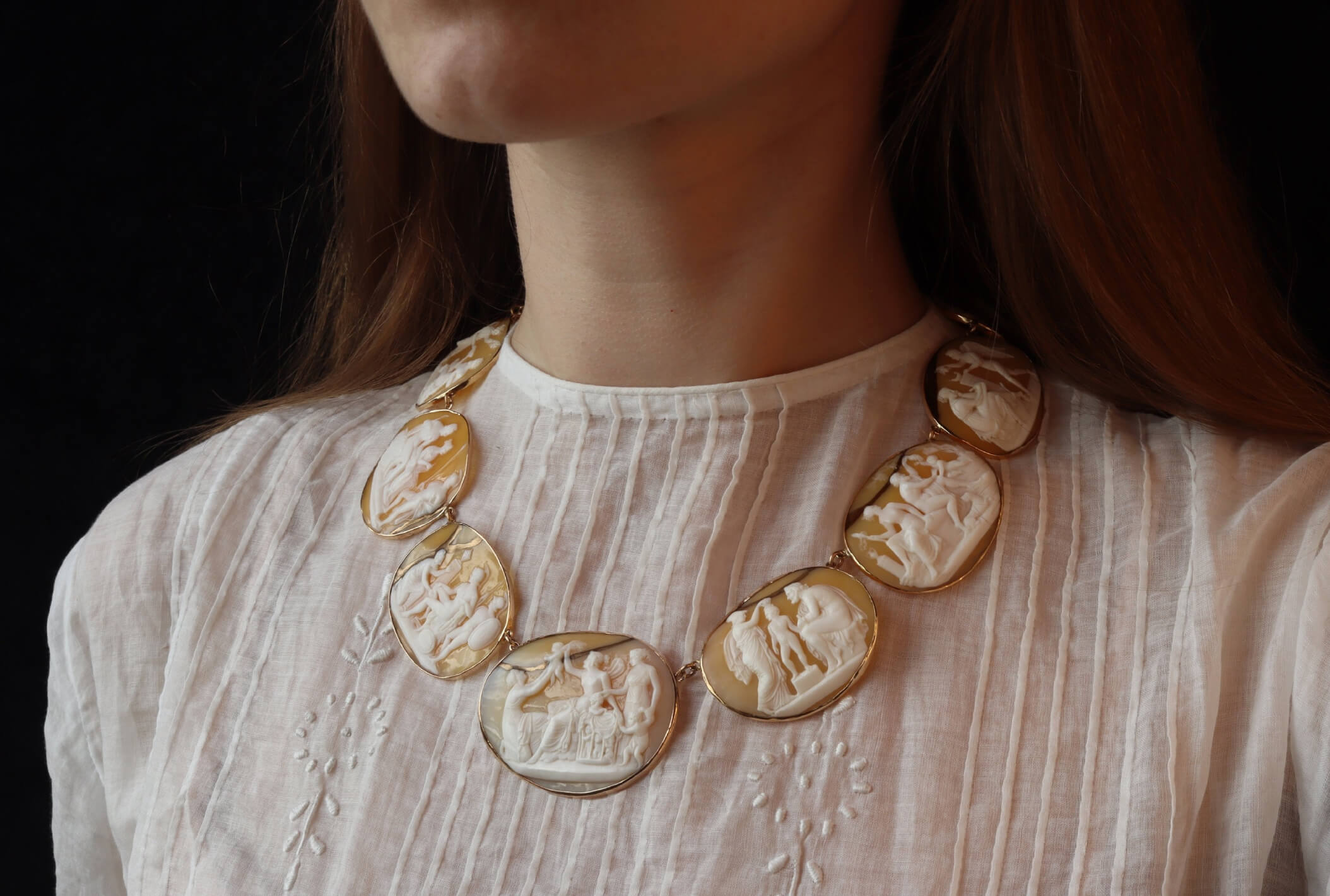
Humanism, with its focus on the individual and the study of classical antiquity, provided the philosophical foundation. Ancient cameos, intaglios and coins were rediscovered, collected and copied, linking the present to the idealised world of Greece and Rome. Mythological and allegorical subjects entered the goldsmith’s repertoire, expressing moral and philosophical themes in miniature, while the ideal of measured beauty that governed architecture and painting found its counterpart in the symmetry, proportion and refined lines of Renaissance jewellery.
The Renaissance is often considered a foundation for the modern concept of design. Drawings, printed pattern books and engravings circulated among workshops, spreading ideas across Europe through diplomacy, trade and the movement of artists. From Italy, the new style reached France, Spain, England and the Low Countries, where courts adapted Italian models to local taste; Antwerp in particular became a flourishing trade centre producing jewels of cosmopolitan design. German workshops, particularly in Nürnberg and Augsburg, are well documented for their technical excellence in engraving and metalwork, so that by the end of the sixteenth century Renaissance ornament had become a shared European artistic language.
3. Visual Characteristics, Materials and Techniques
Renaissance jewellery reveals a gradual evolution from medieval forms toward the measured harmony of classical art. In the early phase, designs still echoed Gothic structure but softened into clearer geometry and natural rhythm. Gold surfaces were delicately chased and enamelled, and set with table cut gems in symmetrical patterns, while motifs such as leaves, pomegranates and acanthus scrolls bridged medieval symbolism and the new classical order.
By the high Renaissance, symmetry, proportion and balance had become guiding principles. Figures from classical mythology appeared in pendants and cameos, expressing both erudition and sensuality, and coloured enamels reached great refinement in both translucent and opaque palettes. Reliefs and miniature sculptures in enamel or cast gold show the influence of artistic ideals associated with figures such as Raphael and Michelangelo, and more directly of goldsmiths such as Cellini, so that each jewel aspired to the same harmony of body and spirit that defined the arts of the period.
In many late sixteenth-century examples, decoration grew more elaborate and theatrical. Designs increased in scale and complexity, often featuring pearls, diamonds and enamelled grotesques inspired by ancient Roman ornament, framed by architectural scrollwork and masks that reflected the mannerist taste for movement and surprise, yet still disciplined by classical order. Across the period, goldsmiths mastered coloured enamels, intricate filigree and the mounting of gems in closed settings, creating jewellery that combined technical perfection with considered design.
4. Function and Meaning (Symbolism)
Renaissance jewellery united faith, reason and feeling within a single artistic language. Its symbols drew on Christian belief, classical mythology and the humanist celebration of earthly life, so that biblical and mythological figures could appear side by side. Allegories of virtue, love and wisdom expressed moral teaching in visual form, and gems themselves carried symbolic value, with rubies that were commonly associated with passion and courage, sapphires with truth, emeralds with hope and pearls with purity, forming a language of colour understood across Europe.
Equally important was the personal dimension. Portrait medallions, lockets and miniature reliquaries preserved the memory of loved ones, while rings engraved with mottoes or enamelled with initials proclaimed affection or loyalty. Religious pendants could hold relics or prayers, and cameos and intaglios bearing classical heroes reflected the owner’s education and taste, so that such jewels functioned as tokens of identity and emotion as well as adornment. At the same time it is important to remember that perhaps most jewels in the Renaissance jewellery style were created and worn simply because their materials, colours or forms appealed, without any further intention than beauty and attraction.
In this way, Renaissance jewellery stood at the meeting point of faith, philosophy and art. Beauty was seen as a reflection of divine order, and craftsmanship as a form of praise, so that each jewel was intended to please the eye while also engaging the mind and conscience.
5. Notable Creators and Exemplary Pieces
The Renaissance elevated the goldsmith to the rank of artist. In Italy, masters such as Benvenuto Cellini, Caradosso Foppa and Giulio Romano linked jewellery to the broader world of sculpture and architecture, defining a classical vocabulary of form and ornament. Workshops in Florence, Milan and Venice achieved high mastery of enamelling, gem setting and design, producing pendants, reliquaries and girdle chains that combined sculptural richness with careful proportion.
Beyond Italy, the Renaissance spirit took diverse forms. In Germany, Wenzel Jamnitzer of Nürnberg turned metalwork into a study of geometry and natural science, while Albrecht Dürer, though primarily a painter and engraver, influenced jewellery design through ornamental prints that circulated among craftsmen. In England Hans Holbein the Younger designed court jewellery of notable clarity and symbolism for Henry VIII and his circle, and in France royal goldsmiths such as Pierre Mangot, and sculptors such as Germain Pilon who provided models for goldsmiths, contributed to the refinement of form and the synthesis between sculpture and jewellery at court.
Among the most celebrated objects of the time are enamelled pendants in sculptural relief depicting mythological or religious scenes, often hung with pearls or table cut gems, and cameos or intaglios mounted in richly decorated frames. Chains, girdles and miniature portraits reflect both personal devotion and humanist pride, and together these pieces illustrate a culture that regarded craftsmanship as an art of intellect and imagination.
6. Recognition in Practice (How to Recognise the Style)
Renaissance jewellery is often recognisable by its classical harmony, sculptural depth and richness of surface. Designs are usually symmetrical, built around a central stone or figure enclosed within a balanced architectural frame. Scrolls, foliage, putti and grotesque masks often fill the surrounding space, while small pendant pearls add movement and light, giving an overall impression of controlled splendour. Motifs reveal the blend of Christian and classical thought characteristic of the age: mythological figures such as Venus, Mercury or Hercules appear beside saints, angels and biblical scenes, the human figure is idealised and anatomically considered, and many decorative details derive from ancient Roman ornament and the rediscovered grotesques of the Domus Aurea. Architectural elements such as columns, arches and pilasters frequently structure the composition so that the jewels can resemble miniature buildings.
Technical features further distinguish the style. Settings are generally closed at the back and often foil backed to intensify the colour of the stones, and enamel is used extensively both for colour and to enrich reliefs in translucent layers of red, blue, green or white. Table cut and point cut diamonds, rubies, emeralds and sapphires are often mounted in relatively high collets or box settings, while filigree, granulation and minute chasing testify to the goldsmith’s precision; clasps and reverse sides are carefully finished, sometimes engraved or enamelled with coats of arms or moral inscriptions. Many surviving pieces have a sculptural quality that recalls bronze medals or relief panels: compared with medieval jewellery they feel more architectural and intellectually ordered, and compared with later Baroque or Rococo designs they appear more restrained and proportioned, their beauty lying in a characteristic equilibrium between geometry and grace.
7. Legacy and Related Styles
The Renaissance marked the birth of a more self-aware artistic culture. Its balanced forms and classical ideals shaped the visual language of Europe for centuries, providing the foundation from which the Baroque emerged. In seventeenth-century jewels the architectural frames and mythological motifs of the late sixteenth century evolved into more dynamic compositions, where rhythm replaced strict symmetry and grandeur replaced restraint, but the underlying vocabulary remained recognisably rooted in Renaissance precedent.
The intellectual and technical advances of Renaissance goldsmiths also endured. Their study of anatomy, geometry and proportion helped define the role of the artist jeweller, uniting invention with craftsmanship, and their work became a touchstone for later revival styles. During the nineteenth century, renewed fascination with the art of the past produced a Neo Renaissance jewellery revival, in which pendants, chains and enamelled settings were created in conscious dialogue with museum pieces and earlier drawings, often with a more romantic than archaeological spirit. In this sense the Renaissance never entirely disappeared: its belief in proportion, reason and the dignity of art continues to inform European taste, and every jewel that seeks harmony between intellect and beauty still carries something of its enduring spirit.
8. Purpose of This Page
This page offers an overview of the historical Renaissance jewellery style within the context of jewellery history and design. It focuses on what is relevant from the perspective of the jewellery world and does not aim to be a full encyclopaedia on the Renaissance jewellery style. Instead, it strives to offer a concise and structured introduction that outlines key interpretive angles and points towards deeper study. This page is part of the Adin Glossary, a curated resource that brings documented historical knowledge into an ordered and accessible structure. Use and sharing for educational purposes are welcomed, and readers who reference or quote this page are kindly asked to mention Adin as their source.
9. Accuracy Note
Every effort has been made to present this information accurately and in line with current historical understanding. Interpretations may evolve as new research becomes available, and readers who notice points for refinement are welcome to share their insights.
10. Author Attribution
Elkan Wijnberg, Jewellery Historian and Antique Jewellery Specialist – Adin – www.antiquejewel.com