
Adin Glossary: Styles and periods

Restoration France jewellery

circa 1814 to 1830, smooth chased gold, crowns, balanced neoclassical frame

1. Introduction

Restoration France jewellery belongs to the Bourbon Restoration, circa 1814 to 1830, and reflects a return to order and controlled refinement after Napoleon’s abdication and final defeat. Makers drew on late neoclassical traditions but softened them with gentler forms, smooth gold grounds and modest ornament.

Pieces often balance quiet political symbolism with elegant understatement, using royalist emblems and restrained classical motifs alongside restrained gemstone accents such as small stones cut and selected to fit, frequently in closed back settings.

2. Cultural and Historical Influences

The style developed with the reestablishment of the Bourbon monarchy after years of revolution and empire. The political climate favoured imagery signalling continuity and legitimacy, while neoclassicism remained the dominant vocabulary, now moderated by renewed courtly taste.

Parisian workshops and merchants served a growing middle class that preferred refined yet discreet adornment, so the jewellery often combines courtly reference with measured, wearable design.

3. Visual Characteristics and Materials

Restoration France jewellery is characterised by restrained neoclassical symmetry combined with royalist themes. Gold, often 18 carat (750), dominates, typically finished as smooth, finely chased surfaces with carefully balanced outlines and controlled ornament.

Motifs such as laurel wreaths, crowns, lilies and classical scrolls appear with moderation rather than display. Gemstones are usually secondary, set as small stones cut and selected to fit, often in closed back settings that can give a warm reflective tone.

4. Function and Meaning

Many pieces carry political meaning, expressing loyalty to the restored Bourbon monarchy through motifs such as lilies, crowns and laurel wreaths. The measured neoclassical framework supports a visual language of dignity and restraint. At the same time it is important to remember that perhaps most Restoration France jewellery pieces were created and worn simply because their materials, colours or forms appealed, without any further intention than beauty and attraction.

Alongside civic symbolism, sentimental jewels such as portrait miniatures and hairwork lockets emphasise personal and familial bonds, linking public allegiance with private remembrance.

5. Workshops and Exemplary Pieces

Production centred on Parisian workshops, operating within hallmarking systems and established craft traditions. Many makers are identifiable only by their marks, while firms active in the Napoleonic era continued under the restored monarchy, adapting designs to the new climate.

Typical pieces include gold pendants and brooches with lily or laurel ornament, miniature portrait lockets framed by smooth neoclassical settings, and rings with finely chased shoulders, all favouring elegant understatement over grandeur.

6. How to Recognise the Style

Look for refined goldwork with smooth surfaces, precise chasing and balanced symmetry, often with modest neoclassical frames. Royalist emblems, especially lilies, crowns and laurel wreaths, are common but are presented in a controlled, understated manner.

Gemstones tend to be small, with stones cut and selected to fit, frequently set in closed back settings, sometimes foil backed, that can create a warm reflective tone. Portrait miniatures, lockets and hairwork pieces often appear in simple, dignified settings.

7. Related Styles and Legacy

Restoration France bridges late eighteenth century neoclassicism and the later nineteenth century turn to historicist reference. It follows the Empire period’s formal language but replaces martial emphasis with quieter royalist symbolism and measured refinement.

Its legacy includes the continued use of classical motifs and the sustained popularity of sentimental jewellery formats that remained influential through much of the nineteenth century.

8. Purpose of This Page

This page offers an overview of the historical Restoration France jewellery style within the context of jewellery history and design. It focuses on what is relevant from the perspective of the jewellery world and does not aim to be a full encyclopaedia on the Restoration France jewellery style. Instead, it strives to offer a concise and structured introduction that outlines key interpretive angles and points towards deeper study. This page is part of the Adin Glossary, a curated resource that brings documented historical knowledge into an ordered and accessible structure. Use and sharing for educational purposes are welcomed, and readers who reference or quote this page are kindly asked to mention Adin as their source.

9. Accuracy Note

Every effort has been made to present this information accurately and in line with current historical understanding. Interpretations may evolve as new research becomes available, and readers who notice points for refinement are welcome to share their insights.

10. Author Attribution

Elkan Wijnberg, Jewellery Historian and Antique Jewellery Specialist – Adin – www.antiquejewel.com
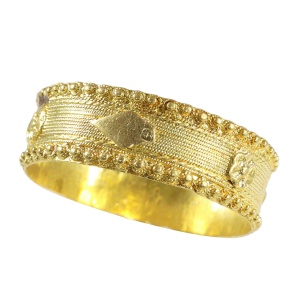
Smooth chased gold with lilies, crowns and laurel wreaths, set within balanced neoclassical frames in a controlled, dignified style.

circa 1814 to 1830

Bourbon Restoration and royalist politics, post revolutionary and post Napoleonic France, softened late neoclassicism, French court and royalist circles, Parisian urban workshops, growing middle class taste for discreet refinement, search for stability, continuity and legitimacy, early nineteenth century French hallmarking and established craft practice

France, Paris

Bourbon lilies, royal crowns and coronets, laurel wreaths and classical scrolls, balanced neoclassical frames, small stones cut and selected to fit in closed back settings, portrait miniatures and lockets, sentimental hairwork pieces, modest pendants and brooches with royalist emblems, smooth gold grounds with fine chasing

gold, often 18 carat (750), occasional use of coloured gemstones and small diamonds, small stones cut and selected to fit in closed back settings, miniature portraits usually on ivory, sometimes on enamel, hairwork contained in lockets or rings

finely chased and polished goldwork, restrained neoclassical engraving, closed back gem settings, sometimes foil backed, that can create a warm reflective tone, precise hand finishing of smooth surfaces and balanced outlines, construction of portrait lockets and sentimental jewels with discreet royalist motifs

Neoclassicism, British Regency, Empire

Court Ornament (court splendour, ornament as display)

Adin Academy

Restoration France jewellery

No items found.

1. Introduction

Restoration France jewellery belongs to the Bourbon Restoration, circa 1814 to 1830, and reflects a return to order and controlled refinement after Napoleon’s abdication and final defeat. Makers drew on late neoclassical traditions but softened them with gentler forms, smooth gold grounds and modest ornament.

Pieces often balance quiet political symbolism with elegant understatement, using royalist emblems and restrained classical motifs alongside restrained gemstone accents such as small stones cut and selected to fit, frequently in closed back settings.

2. Cultural and Historical Influences

The style developed with the reestablishment of the Bourbon monarchy after years of revolution and empire. The political climate favoured imagery signalling continuity and legitimacy, while neoclassicism remained the dominant vocabulary, now moderated by renewed courtly taste.

Parisian workshops and merchants served a growing middle class that preferred refined yet discreet adornment, so the jewellery often combines courtly reference with measured, wearable design.

3. Visual Characteristics and Materials

Restoration France jewellery is characterised by restrained neoclassical symmetry combined with royalist themes. Gold, often 18 carat (750), dominates, typically finished as smooth, finely chased surfaces with carefully balanced outlines and controlled ornament.

Motifs such as laurel wreaths, crowns, lilies and classical scrolls appear with moderation rather than display. Gemstones are usually secondary, set as small stones cut and selected to fit, often in closed back settings that can give a warm reflective tone.

4. Function and Meaning

Many pieces carry political meaning, expressing loyalty to the restored Bourbon monarchy through motifs such as lilies, crowns and laurel wreaths. The measured neoclassical framework supports a visual language of dignity and restraint. At the same time it is important to remember that perhaps most Restoration France jewellery pieces were created and worn simply because their materials, colours or forms appealed, without any further intention than beauty and attraction.

Alongside civic symbolism, sentimental jewels such as portrait miniatures and hairwork lockets emphasise personal and familial bonds, linking public allegiance with private remembrance.

5. Workshops and Exemplary Pieces

Production centred on Parisian workshops, operating within hallmarking systems and established craft traditions. Many makers are identifiable only by their marks, while firms active in the Napoleonic era continued under the restored monarchy, adapting designs to the new climate.

Typical pieces include gold pendants and brooches with lily or laurel ornament, miniature portrait lockets framed by smooth neoclassical settings, and rings with finely chased shoulders, all favouring elegant understatement over grandeur.

6. How to Recognise the Style

Look for refined goldwork with smooth surfaces, precise chasing and balanced symmetry, often with modest neoclassical frames. Royalist emblems, especially lilies, crowns and laurel wreaths, are common but are presented in a controlled, understated manner.

Gemstones tend to be small, with stones cut and selected to fit, frequently set in closed back settings, sometimes foil backed, that can create a warm reflective tone. Portrait miniatures, lockets and hairwork pieces often appear in simple, dignified settings.

7. Related Styles and Legacy

Restoration France bridges late eighteenth century neoclassicism and the later nineteenth century turn to historicist reference. It follows the Empire period’s formal language but replaces martial emphasis with quieter royalist symbolism and measured refinement.

Its legacy includes the continued use of classical motifs and the sustained popularity of sentimental jewellery formats that remained influential through much of the nineteenth century.

8. Purpose of This Page

This page offers an overview of the historical Restoration France jewellery style within the context of jewellery history and design. It focuses on what is relevant from the perspective of the jewellery world and does not aim to be a full encyclopaedia on the Restoration France jewellery style. Instead, it strives to offer a concise and structured introduction that outlines key interpretive angles and points towards deeper study. This page is part of the Adin Glossary, a curated resource that brings documented historical knowledge into an ordered and accessible structure. Use and sharing for educational purposes are welcomed, and readers who reference or quote this page are kindly asked to mention Adin as their source.

9. Accuracy Note

Every effort has been made to present this information accurately and in line with current historical understanding. Interpretations may evolve as new research becomes available, and readers who notice points for refinement are welcome to share their insights.

10. Author Attribution

Elkan Wijnberg, Jewellery Historian and Antique Jewellery Specialist – Adin – www.antiquejewel.com
Also known as:

References