
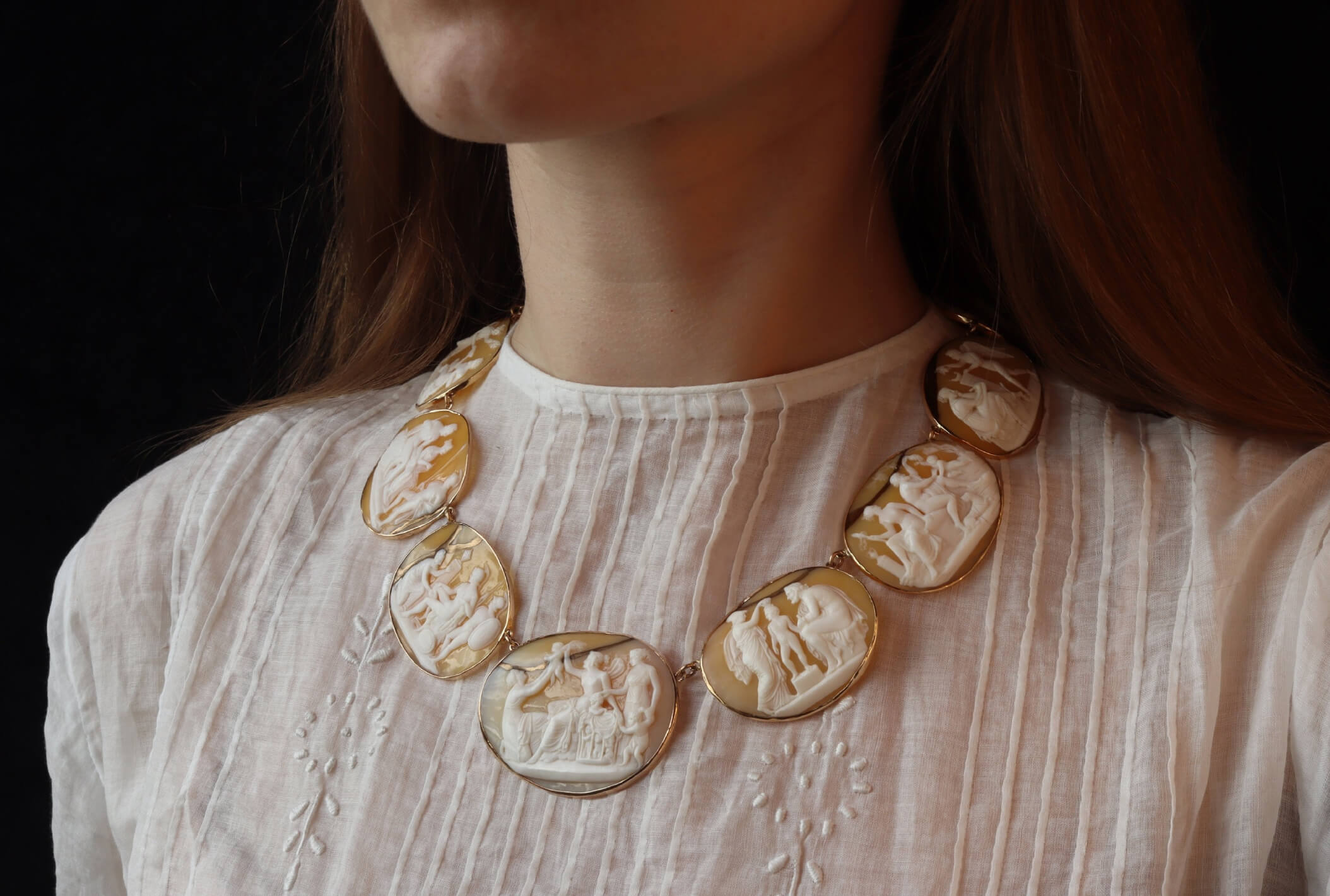
See our: shell cameo jewelry.A type of cameo that is cut in shell rather than in a hardstone. Suchcameos have been made from many (at least ten) varieties of mollusc shell, especially those having, under the dark mottled outer layer that is usually removed and discarded, two colours, i.e. a whitelayer into which the design is cut in relief, and o lower layer (ranging from brown and violet to pink) which serves as the contrasting ground.Shells of several kinds of mollusc have been used:Cassis mollusc, a genus that includes the 'Helmet conch', the 'Cameo conch', and the 'queen conch', the shells of all of which provide a brownish ground.Strombus mollusc, a genus that includes the 'Giant conch' and the 'Fountain conch', the shells of both of which provide a pink ground.Shell cameos are cut by hand tools, not carved as is a gemstone cameo. The subjects depicted include Classical motifs, ruins, portraits of mythological characters and, later, portraits ofcontemporary personages. Some cameos were set in gold mounts, sometimes surrounded with gemstones or seed pearls, or the inferior ones in rolled gold, in pinchbeck or in gilded metal.They were worn as a brooch, earring, finger ring, pendants on a necklace, etc.Such shell cameos were made in France and Italy from c. 1500, and became popular as jewelry in England and elsewhere in the early 19th century; in England they lost favour to the medallions ofWedgwood and Tassie, but were revived in the mid-19th century and continued in wide usage into the 20th century, especially in Italy, where the centres of production were around Naples and in Sicily.In the late 19th century the standard of craftsmanship deteriorated, and in recent years imitations have been moulded in plastic and mounted in cheap settings.
Shell Cameo
Shell Cameo
See our: shell cameo jewelry.A type of cameo that is cut in shell rather than in a hardstone. Suchcameos have been made from many (at least ten) varieties of mollusc shell, especially those having, under the dark mottled outer layer that is usually removed and discarded, two colours, i.e. a whitelayer into which the design is cut in relief, and o lower layer (ranging from brown and violet to pink) which serves as the contrasting ground.Shells of several kinds of mollusc have been used:Cassis mollusc, a genus that includes the 'Helmet conch', the 'Cameo conch', and the 'queen conch', the shells of all of which provide a brownish ground.Strombus mollusc, a genus that includes the 'Giant conch' and the 'Fountain conch', the shells of both of which provide a pink ground.Shell cameos are cut by hand tools, not carved as is a gemstone cameo. The subjects depicted include Classical motifs, ruins, portraits of mythological characters and, later, portraits ofcontemporary personages. Some cameos were set in gold mounts, sometimes surrounded with gemstones or seed pearls, or the inferior ones in rolled gold, in pinchbeck or in gilded metal.They were worn as a brooch, earring, finger ring, pendants on a necklace, etc.Such shell cameos were made in France and Italy from c. 1500, and became popular as jewelry in England and elsewhere in the early 19th century; in England they lost favour to the medallions ofWedgwood and Tassie, but were revived in the mid-19th century and continued in wide usage into the 20th century, especially in Italy, where the centres of production were around Naples and in Sicily.In the late 19th century the standard of craftsmanship deteriorated, and in recent years imitations have been moulded in plastic and mounted in cheap settings.
References
From: An Illustrated Dictionary of Jewelry, autor: Harold Newman, publishers: Thames and Hudson