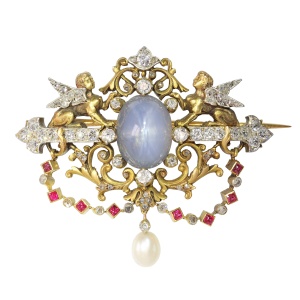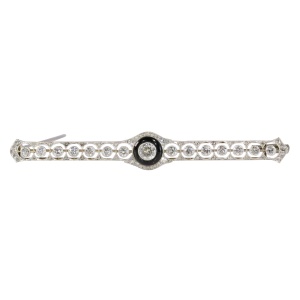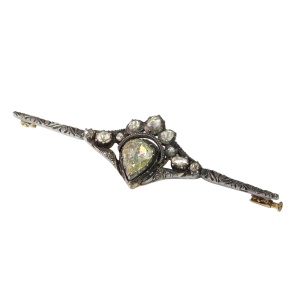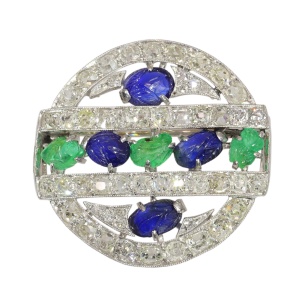

The process of joining pieces of metal by the insertion of solder (molten metal) having a melting point lower than that of the metals to be joined. It is usedin making and repairing jewelry. If the solder has a melting point only slightly below that of the metal pieces, it penetrates the metal and makes a firm join (called 'hard soldering' or sometimes'brazing'); if its melting point is much lower it makes a weaker join (called 'soft soldering) that is seldom practicable for jewelry. The pieces to be joined must have clean surfaces and be coatedwith a flux to dissolve the oxide film that would impede the join, and after fusing the piece must be dipped in pickle to remove the flux.Soldering was used in Mesopotamia from the 3rd millennium BC and in Minoan civilization from the 2nd millennium BC; the ancient process involved binding the pieces together with a metal wire andapplying heat which would cause the base metal of the wire to oxidize, and so it required that the surface of the wire be coated with a flux (e.g. wine lees or natron) to prevent oxidation.
Soldering
Soldering
The process of joining pieces of metal by the insertion of solder (molten metal) having a melting point lower than that of the metals to be joined. It is usedin making and repairing jewelry. If the solder has a melting point only slightly below that of the metal pieces, it penetrates the metal and makes a firm join (called 'hard soldering' or sometimes'brazing'); if its melting point is much lower it makes a weaker join (called 'soft soldering) that is seldom practicable for jewelry. The pieces to be joined must have clean surfaces and be coatedwith a flux to dissolve the oxide film that would impede the join, and after fusing the piece must be dipped in pickle to remove the flux.Soldering was used in Mesopotamia from the 3rd millennium BC and in Minoan civilization from the 2nd millennium BC; the ancient process involved binding the pieces together with a metal wire andapplying heat which would cause the base metal of the wire to oxidize, and so it required that the surface of the wire be coated with a flux (e.g. wine lees or natron) to prevent oxidation.
References
From: An Illustrated Dictionary of Jewelry, autor: Harold Newman, publishers: Thames and Hudson