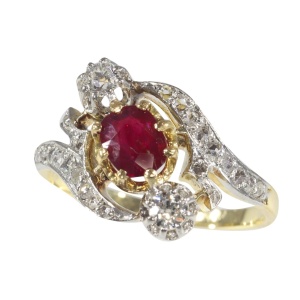

A synthetic gemstone resembling the natural ruby. The first synthetic rubies were attempted by Marc Gaudin in 1837, and by 1877 thin platy crystals of ruby wereproduced by the French chemists Edmond Frémy and Charles Feil; later Frémy and Auguste Verneuil succeeded in producing rubies large enough tobe rose cut, but too small for general use as jewelry. A so-called reconstructed stone having the appearance of a ruby was produced c. 1885. Successful resultsfrom the Verneuil Furnace process, using as a colouring agent oxide of chromium, were published in 1904, and today synthetic rubies (including the syntheticpigeon's-blood ruby) are commercially produced by modifications of that method, and also by the advanced hydrothermal process and flux fusionprocess. Synthetic rubies can be distinguished by the often 'too perfect' colour, by curved rather than straight striae, and by the typical internal bubbles, and sometimes by ultraviolet and X-raytests.
Synthetic Ruby
Synthetic Ruby
A synthetic gemstone resembling the natural ruby. The first synthetic rubies were attempted by Marc Gaudin in 1837, and by 1877 thin platy crystals of ruby wereproduced by the French chemists Edmond Frémy and Charles Feil; later Frémy and Auguste Verneuil succeeded in producing rubies large enough tobe rose cut, but too small for general use as jewelry. A so-called reconstructed stone having the appearance of a ruby was produced c. 1885. Successful resultsfrom the Verneuil Furnace process, using as a colouring agent oxide of chromium, were published in 1904, and today synthetic rubies (including the syntheticpigeon's-blood ruby) are commercially produced by modifications of that method, and also by the advanced hydrothermal process and flux fusionprocess. Synthetic rubies can be distinguished by the often 'too perfect' colour, by curved rather than straight striae, and by the typical internal bubbles, and sometimes by ultraviolet and X-raytests.
References
From: An Illustrated Dictionary of Jewelry, autor: Harold Newman, publishers: Thames and Hudson