
Dragon

This glossary entry has not yet been updated and is under review.
dragon

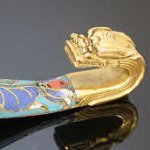
See our:dragon (griffin) jewelry or ourmythological jewelry.Articles of jewelry whose principal decorative motif is the representation of a dragon, a fabulous animal in the form of a large winged and scaly lizard with large claws. A related piece depicted asea dragon, having a fishtail instead of claws.Examples were made of jade in China; some Renaissance examples are often in the form of a baroque pearl jewel with the pearl forming the body and withthe head and claws (or tail) of gold with coloured enamelling and set with gemstones. The dragon was usually a decorative motif on a pendant but sometimes ornamented a toothpick.

Dragon

Chuang Tzu taught that the power of the dragon is a mysterious thing. It is the resolution of opposites. This is why, he said, Confucius dwelt in Lao-Tzu, the very personification of the dragon.In any case, while dragons may confer immortality, Chinese dragons take you to it, since they are the winged steeds of the Immortals, too.Thanks to a dragon Yu the Great was able to set the world to rights by draining off the over abundant waters. The dragon was sent to him from Heaven and 'opened the way' for him. It was quitenatural for the dragon, a celestial, creative and law-giving power, to become the symbol of the Emperor. This is how they became an imperial emblem.Because dragons and griffins may get confused we also have an explanation on griffins.
Explanation on dragon by Adin antique vintage and estate jewelry
Adin Academy

Dragon

No items found.
dragon

See our:dragon (griffin) jewelry or ourmythological jewelry.Articles of jewelry whose principal decorative motif is the representation of a dragon, a fabulous animal in the form of a large winged and scaly lizard with large claws. A related piece depicted asea dragon, having a fishtail instead of claws.Examples were made of jade in China; some Renaissance examples are often in the form of a baroque pearl jewel with the pearl forming the body and withthe head and claws (or tail) of gold with coloured enamelling and set with gemstones. The dragon was usually a decorative motif on a pendant but sometimes ornamented a toothpick.

Dragon

Chuang Tzu taught that the power of the dragon is a mysterious thing. It is the resolution of opposites. This is why, he said, Confucius dwelt in Lao-Tzu, the very personification of the dragon.In any case, while dragons may confer immortality, Chinese dragons take you to it, since they are the winged steeds of the Immortals, too.Thanks to a dragon Yu the Great was able to set the world to rights by draining off the over abundant waters. The dragon was sent to him from Heaven and 'opened the way' for him. It was quitenatural for the dragon, a celestial, creative and law-giving power, to become the symbol of the Emperor. This is how they became an imperial emblem.Because dragons and griffins may get confused we also have an explanation on griffins.
Also known as:

References