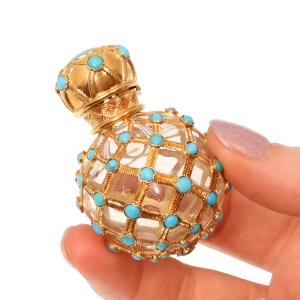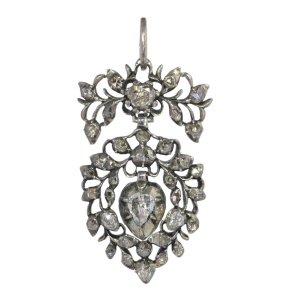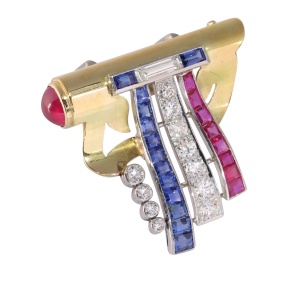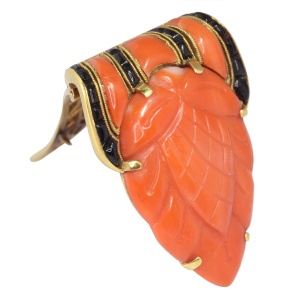

The technique of decorating various materials (e.g. gold, silver, copper, porcelain, glass, but as to jewelry usually on the first three) by the use of enamel on the surface to paint scenes, figuresor inscriptions or in grooves or depressions in metal by filling in certain areas.The process of using enamel colours was known in Egypt from about 1600 BC and in the Mycenaean world from about 1400 BC; it was used to a limited extent in Greece but extensively in Byzantium in the6th century, in Venice from the 15th century, and elsewhere in Europe from the 16th century, especially at Limoges, which became a centre for decorating with painted enamel.It was used in Britain from the 9th century, and especially from c. 1750. It has been used to decorate jewelry by all of the above-mentioned methods, employing a base of gold, silver, or copper, andsometimes iron or bronze for use with opaque enamel; it has also been used on a glass or crystal base and on figures and relief work.Enamelling on metal by painting was originally unsuccessful but was solved by counter-enamelling.
Enamelling
Enamelling
The technique of decorating various materials (e.g. gold, silver, copper, porcelain, glass, but as to jewelry usually on the first three) by the use of enamel on the surface to paint scenes, figuresor inscriptions or in grooves or depressions in metal by filling in certain areas.The process of using enamel colours was known in Egypt from about 1600 BC and in the Mycenaean world from about 1400 BC; it was used to a limited extent in Greece but extensively in Byzantium in the6th century, in Venice from the 15th century, and elsewhere in Europe from the 16th century, especially at Limoges, which became a centre for decorating with painted enamel.It was used in Britain from the 9th century, and especially from c. 1750. It has been used to decorate jewelry by all of the above-mentioned methods, employing a base of gold, silver, or copper, andsometimes iron or bronze for use with opaque enamel; it has also been used on a glass or crystal base and on figures and relief work.Enamelling on metal by painting was originally unsuccessful but was solved by counter-enamelling.
References
From: An Illustrated Dictionary of Jewelry, autor: Harold Newman, publishers: Thames and Hudson