

Chronicles



Happy 2014! And thank you for having the good tasteto call upon our expertise.

Specific Art Nouveau Jewelry, Female faces on pendants, lockets and brooches
Art Nouveau (French for "New Style") is an international movement and style of art, architecture, and applied art—especially the decorative arts—that peaked in popularity at the turn of the 20th century (1890–1905). The name "Art Nouveau" is indeed French for "new art". It is also known as Jugendstil, German for "youth style," named after the magazine Jugend, which promoted it. In Italy, it is referred to as Stile Liberty, after the London department store Liberty & Co., which popularised the style. In Holland, it is known as “Sla-olie-stijl,” Dutch for “salad oil style,” after an advertisement poster for this product created in that style.
A reaction to the academic art of the 19th century, Art Nouveau is characterised by organic, especially floral and other plant-inspired motifs, as well as highly stylised, flowing curvilinear forms. It represents an approach to design in which artists believed they should work on everything from architecture to furniture, making art an integral part of everyday life.
Although Art Nouveau fell out of favour with the advent of 20th-century modernist styles, it is now recognised as an important bridge between the historicism of Neoclassicism and modernism.
Click here to get to our collection of this specific Art Nouveau jewelry.

Under The Mistletoe... In The Mistletoe... Who cares? They're both worth a kiss.

The Garden of Adin's Poulterer Presents: Fattened Pheasant for the Jolly Vegetarian!

Let it snow, let it snow, let it snow...

Most Pertinent Weather Forecast Ever: It's going to be a sparkling white Christmas !

Elegant antique crossover ring with rubies and diamonds, or as the French so romantically call it: a "toi et moi" (you and me).
This late-Victorian ring was made around 1900. The Victorian era is renowned for its eclectic revival and reinterpretation of historic styles, as well as the introduction of cross-cultural influences from the Middle East and Asia in furniture, fittings, and interior decoration. Victorian design is widely regarded as being heavily adorned with an excess of ornamentation.
This ring exemplifies the transition of styles from the Victorian era to those of the 20th century. The Arts and Crafts movement, the Aesthetic movement, the Anglo-Japanese style, and the Art Nouveau style all have their origins in the late Victorian period.

What are the scientific similarities between an antique ring and a Romanesco broccoli?

One of our many new arrivals...
Biedermeier skillfully carved ivory brooch featuring two dogs standing within a flowery framework. Different times bring different opinions and morals. In the first quarter of the 19th century, people's attitudes towards what are now endangered species, due in part to those very attitudes, were markedly different from our own (to put it mildly). We strongly condemn the use of ivory today, but in our trade, we sometimes encounter beautiful antique pieces of ivory, such as this one. And what a beauty it is! The meticulously refined sculpting and engraving are a joy to behold. Just look at the collar holding the dogs together, or their legs! We have never seen such fine work, and to think it has survived nearly 200 years!
This brooch is a typical example of mid-European Biedermeier art. The Biedermeier period refers to an era in Central Europe during which the middle class grew, and the arts appealed to common sensibilities. This historical period spanned from 1815, the year of the Congress of Vienna at the end of the Napoleonic Wars, to 1848, the year of the European revolutions.

Art Deco Ring, so tempting......

Art Nouveau Beauty
A splendid Art Nouveau enamelled rose gold pendant-brooch featuring two old mine diamonds, a rose-cut diamond, and a hanging pearl. It was crafted using a technique called plique-à-jour, in which translucent enamel is fired between thin gold wires to create the delicate veined wings adorning this brooch.
The precise intricacies of soft colour transitions within the face, along with the delicate enamelling of the flower, make this a true collector’s artefact. Undoubtedly, this is a very refined piece in extremely good condition.
This beauty is equally striking when worn as either a brooch or a pendant.
Click here for more info on this Art Nouveau jewel with plique-à-jour enamel.

Oh Darling, you don't have to buy me a big present this Christmas. They have small expensive pieces at Adin too!

Going back to the roots....

Go Green This Winter!
The Kutchinsky jewellery store was established in London in 1890. The Kutchinsky family originally hailed from Poland, where they had been jewellers for centuries, including serving as jewellers to the Court of Ludwig of Bavaria. After World War II, Kutchinsky was a pioneer in the use of platinum in fine jewellery, and their shop on Commercial Road quickly became a destination for lovers of exquisite jewellery. In the late Fifties, they relocated their business to London's Knightsbridge, where you can still find a Kutchinsky store today, although it has since been taken over by Moussaieff, another illustrious name in the world of high-quality jewellery. Kutchinsky remains renowned for its high-quality jewellery and the use of precious stones.

Memorial ring
After 200 years, still in top condition!
This is a so-called memorial ring. From the mid-1700s to the early 1800s, the well-to-do would allocate a certain part of their financial legacy to have these memory rings made upon their passing. In their will, they would clearly stipulate who would receive such a ring. These rings were then worn by their heirs in memory of their beloved deceased.
In our days, these rings are highly sought after by collectors. On the outside of the shank (the bottom part of the ring), which is enameled with black and white enamel, we can read in gold Gothic letters: "IN MEMORY OF". Inside, the ring has been hand-engraved with: "Mary Ann Edmonds, 06, 26 Jan, 1822 Oct 19".
To read and see more about this ring (including a video), click here.


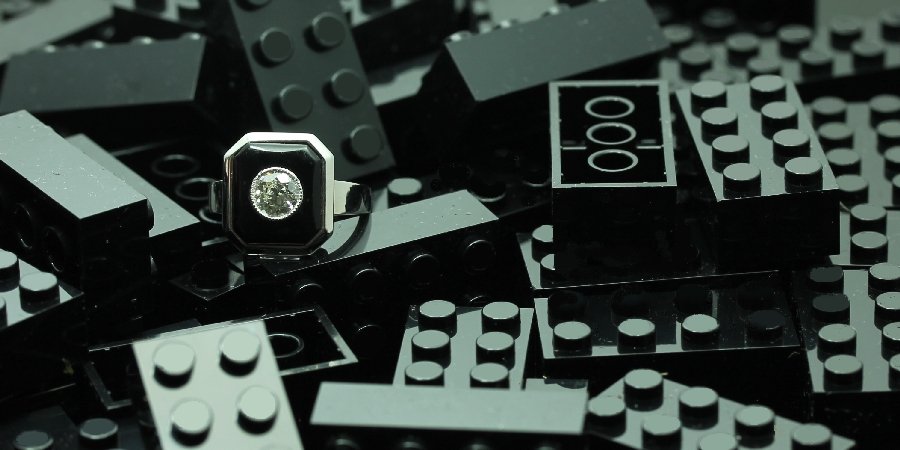
Developments in male construction phases
Christiaan Frederik (Chris) Steenbergen completed his goldsmith training during World War II at the Institute of Applied Art in Amsterdam (IvKNO), which is now known as the Rietveld Academy. In 1946, he earned his master’s certification and began working as an independent jeweller at the Leliegracht in Amsterdam. After his graduation, he briefly collaborated with other well-known jewellery designers, Archibald Dumbar and Esther Swart-Hudig. Steenbergen participated in both national and international exhibitions, and on the occasion of his 65th birthday, a retrospective of his work was held at the Museum Boijmans Van Beuningen in Rotterdam. In 2000, he was honoured with an award from the Foundation for Visual Arts, Design and Architecture for his complete oeuvre.
As a member of the Society of Cooperating Craft Artists (GSA), he regularly exhibited his jewellery. Characteristic of Steenbergen's jewellery designs are sleek and simple forms that emerge from basic shapes such as the square, circle, and ellipse. In combination with gold and silver, Steenbergen occasionally incorporated other materials, such as coloured perspex, ebonite, rock crystal, and slate. The developments in the visual arts were a significant source of inspiration for him. His designs were influenced by the Bauhaus movement, the sculptures of artists such as Henry Moore and Antoine Pevsner, and abstract constructivism. In later years, architecture became a major source of inspiration for his work.
Click here to get to this white gold ring in Art Deco style by artist jeweler Chris Steenbergen.

Antique Big Coral Beads Strand Extremely Rare!
WOW, WOW, and once more, WOW! This must be the most extraordinary coral necklace we have ever had, and most likely ever will have. The beads are enormous! And there are so many—fifty large beads in total! From time to time, we come across an antique coral necklace with perhaps just one large bead of this quality at its centre. But to find a necklace with such an incredible collection of large, high-quality beads is a rarity beyond rare.
The beads are not strung but wired on 14K red gold. The clasp is concealed within a magnificent antique gold filigree sphere, a design typical of 19th-century Dutch craftsmanship. We were astounded when we first discovered it, and we still are. What a beauty!
Click here to get to this antique Dutch big coral bead string with filigree closure.


Halloween dresscode 2013

Harvest time in The Garden of Adin, a great time for plucking its fruits!
This ring was crafted around 1910 in a style known as "The Belle Époque." The Belle Époque (French for "Beautiful Era") was a period in European social history that began in the late 19th century and lasted until World War I. Taking place during the time of the French Third Republic and the German Empire, the "Belle Époque" was named in retrospect, as it came to be seen as a "golden age." During this era, the major powers of Europe experienced advancements in new technologies that improved lives, and the commercial arts adapted Renaissance and eighteenth-century styles to modern forms.
In the newly wealthy United States, emerging from the Panic of 1873, the comparable epoch was dubbed the Gilded Age. In the United Kingdom, this period overlaps with the end of the Victorian Era and the beginning of the Edwardian Era.
Click here to get to this decorative Belle Epoque ring with ruby and diamonds.

This week's bouquet.....

The harvest of aged gold....
The harvest of aged gold is the recollection and abundance of blessings previously secured. (freely adapted from Marcus Tullius Cicero - Roman philosopher 106 BC - 43 BC)
Click here to get to this Art Nouveau ring with cushion cut diamond.

Dutch region specific antique brooch
This jewel is typical of Zeeland, the southernmost coastal province of the Netherlands (Holland). Dutch regional jewellery has a distinctive look and is easily recognisable to the trained eye. This brooch is truly one-of-a-kind, as we have never encountered this type of jewel set with so many diamonds before. It must have been custom-made around 1850 for a very wealthy woman and can be worn both as a brooch and as a pendant.
(click here to get to this beauty)


Carpe Diem (Latin for "gather ye rings while ye may")
Carpe diem is a phrase from a Latin poem by Quintus Horatius Flaccus (65 BC – 8 BC), which has become an aphorism. It is popularly translated as "seize the day". However, a more accurate translation of "Carpe diem" would be "enjoy the day" or "pluck the day (as it is ripe)".
The "Carpe diem" phrase is often misinterpreted and misused in contemporary popular culture. It’s not about ignoring one’s future, but rather about not trusting that everything will fall into place someday and instead taking action today.
So, have a look at these rings and wonder if you really have to wait to make your purchase :-)


Life is like a box of chocolates,, you never know what you're gonna get.


One sweet date to remember...
Or:
Darling, ever since our first date...
Let's take our dates more seriously now; what do you think?
I've loved you since our first date...
Let's make it a special one...
Now, this will be a date you'll never forget...
Men are terrible with dates...
Never on the first date...
The sweetest date...
All thanks to our many dates...
Let's make our dates more serious now...
Click here to get to this sweetie.

The ugly duck ring
Once upon a time, there was a sad and lonely ring, suffering greatly from being misunderstood. Scornfully, it was called the “ugly duck ring”, spending much of its time alone, hidden away in a drawer.
But one day, it wandered from its house and found its way to The Garden of Adin, where it was understood and adored for its beauty. There, it was called the “snugly luck ring”. And since then, the snugly luck ring has happily waited there for someone to give it a new warm and happy home.
Click here to view this beauty.
Soothe your Great Gatsby fever the natural way
with the elemental products of the Garden of Adin

€16,500 click here for our 20th Century Jewelry


€16,000 Having the Great Gatsby fever can be heartbreaking. It's no wonder so many people grab over-the-counter (read: “reproduction”) Art Deco-ish jewelry to soothe their urge! Unfortunately, there isn't much, if any, original Art Deco jewelry available in modern jewelry stores. Luckily for you now there is Adin! There is no doubt that the original Art Deco jewelry from The Garden of Adin is key to combat the terrible Great Gatsby fever. Pampered by the Gardener in the fertile soil of The Garden of Adin, our original Art Deco jewelry achieved its full Gatsby fever-fighting potential. Therefore it is with great delight that we offer our all 100% original Art Deco jewelry for you to try!
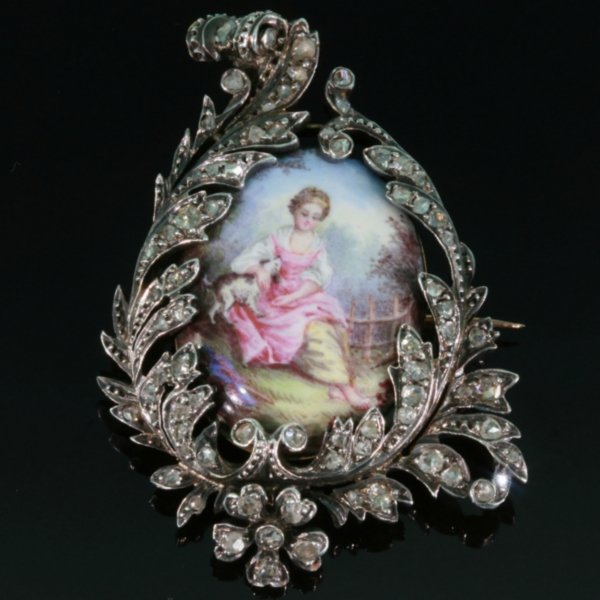
From goddess to femme fatale
Female portrayal through the centuries: Noble ladies from the Garden of Adin
A wife in precious metal, who can find? She is worth far more adorned with rubies or other gems. Her admirers have full confidence in her and lack nothing of value. She brings good, not harm, all the days of their life.
(Freely inspired by Proverbs 31:10-31 "The Wife of Noble Character")
Click here for all our portrait jewelry.


Plique-à-jour enamel earrings
Where true beauty and splendour meet: Art Nouveau long pendent earrings – Art Nouveau as you want it to be. The two rectangular enameled plates are made using a very special technique, known as the plique-à-jour enamelling technique. "Plique-à-jour" comes from French, meaning "braid letting in daylight." It is a very challenging vitreous enamelling technique where the enamel is applied in cells to give a stained glass appearance.
However, these earrings were not originally created as earrings. Most likely, they began their life as decorative elements in a chain or dog-collar necklace during the Art Nouveau period, somewhere between 1890 and 1900. When we acquired them, they had been mounted together in a single brooch. This brooch—more accurately, a bulky gold framework with a needle at the back—was likely made between 1930 and 1950 and specifically designed to hold the two plaques.
Because the framework wasn’t original and did not do justice to the high quality of the original Art Nouveau work, we decided to remount them in a setting that would enhance their beauty. Our master goldsmith carefully separated them from their bulky framework and designed a refined mounting that honours their true splendour. He did so by drawing inspiration from the Art Nouveau style and imagining how a goldsmith from that era might have designed them.
The result is astonishing!
Click here to get to these truly magnificent earrings.

Ode to the ear and its jewel
Freely inspired by "Ode to beer" by Francis Saltus Saltus (1849-1889) What merry fairy, oh pretty, delicious ear, gave thee the power through centuries to maintain a charm that soothes dull care, and laughs at pain. A power sad ears to vitalize and cheer? Thy chaste earlobe with chandelier, or gems so crystal clear. Centuries, histories eager to be worn again, with true passion and even a little vain, it's a pact for many a year, as love token or souvenir.
Click here for all our earrings.

€695 Click the pictures to get to their descriptive pa


Jewellery from the 1600's, a so called Stuart crystal depicting Cupid's arrow smithy
This type of jewel is called a Stuart crystal. Stuart crystals were mounted in all sorts of jewellery, from pins, rings, slides, bracelets, and more. Most of the Stuart crystals that survived over the ages are the slide variety, like this one. They became popular in England after 1649, with the execution of the then King of England, Charles I. His loyalists (the royalists), who wanted to show their sympathy for their fallen monarch, would wear small slides set with his portrait or a tress of hair and his initials (in fine gold wire) underneath a faceted crystal.
These "memento mori" jewels set the spark for a fashion among the aristocracy for memorial crystals. Later in the 17th century, these crystals were also embellished with all sorts of Cupid scenes like this one. The scene depicted here is about three cupids working in what can be recognised as a smithy. One is standing in front of the fire and the two others are hammering on an anvil. In the green enamelled floor of the smithy, in bas-relief, there is a Latin (?) text reading something like "IO CLOMEAL".
The scene is set under a smooth domed faceted rock crystal to a border of Scottish river pearls. Made in the fashionable way of the late 1600s and rather easily recognisable as from that era, the backside of the jewel is enamelled in a pink, black, and white botanical design (leaf motifs) much favoured in the 17th century.
To find a Stuart crystal slide in this quality with these colours and the depicted scene is really rare, even for us. It is with great pride that we can offer this true collector's item here on our site. When wearing it as a slide, it will look beautiful on a simple black velvet ribbon around the neck. And although born as a slide, somewhere in the last 50 of its approximate 350 years' lifetime, a system was added to wear it as a brooch. The craftsman who did it, did a good job as the way the system is attached is reversible. It can be taken on and off reasonably easily and then worn as one wishes, as a brooch or as a slide.
Click here to read and see more about this Stuart crystal slide.


Happy Hedgehog Day!
Hedgehog Day in The Garden of Adin is celebrated on April 14. According to folklore, when a bejewelled hedgehog is spotted on this day in the proximity of a cactus, all Adin friends, family, relatives, and customers will have a flourishing spring and an even more prosperous summer.
It is with great delight that we can share with you that this very day, this once-in-a-lifetime event has happened. We even managed to take a picture of it!
So happy Hedgehog Day!
Click here to read and see more about this estate hedgehog ring

Diamonds are forever (but only since the last 60 years or so)
Although it is said that the tradition of diamond engagement rings and eternity bands goes back a few thousand years, it was not until the mid-twentieth century that they became the tradition we now know them to be. How they became part of a tradition is, all sugar-sweet stories of romance and everlasting love aside, an interesting tale.
In the late 1930s, De Beers, the then world monopolist for diamonds, in an attempt to reduce their growing stock of diamonds, started a now historic advertising campaign. Out of the need to sell the bulk of their "big" stones, the idea of proposing marriage with a one-diamond engagement ring was born. Before that, there simply wasn't a link between a marriage proposal and a one-stone diamond ring.
Some twenty years later, De Beers had a (secret) agreement with the former Soviet Union as the sole channel for diamonds found there. The diamonds coming from Russia, although being better in quality, were much smaller in size. And what was better to get rid of a lot of smaller diamonds at one time? Thus, the eternity band was born.
We proudly present our collection of rose cut diamond, silver set gold backed jewellery
The technique of setting diamonds in gold-backed silver originated centuries ago when jewellers believed that only a silver mounting could render the true beauty of diamonds. Backing the silver jewel with a layer of gold was a practical precaution taken to avoid the silver leaving black stains on clothing or skin.
It was not until the late nineteenth and early twentieth centuries, with the recognition and subsequent use of platinum as a precious metal and the development of white gold, that the practical necessity to use bi-coloured material became obsolete.
The argument to use bi-coloured metals became more of an aesthetic habit than a practical necessity. Goldsmiths continued using bi-coloured metals to emphasise the diamond settings up to the 1950s.
Click here for all our silver on gold jewelry.


We proudly present our collection of high quality Art Retro rings
Retro jewellery (1935-1950) – The Retro style was strongly influenced by its predecessor: the Art Deco style. It used the same types and language of geometrical shapes but with bolder, heavier lines, shapes, and stones.
Typical of the Retro style is its imitation of three-dimensional folds of fabric, with the ribbon bow as its most popular motif, often highlighted in the centre with a calibré cut ruby or sapphire knot (mostly lab-produced stones were used, see also Verneuil rubies and sapphires) and diamonds in various cuts as white accents. Another typical motif for this period is the tank bracelet (based on tank caterpillars).
Gold regained its popularity during the Retro period due to the fact that platinum was not available to goldsmiths and jewellers, as it was being used for the war effort. This was the main reason that different colours of gold became popular during the Retro period – yellow gold was combined with rose gold and green gold in striking combinations. Imagine, in France goldsmiths worked with no less than 27 shades of gold!
The most popular gemstones seen in the Retro style are aquamarine, citrine, topaz, large cabochon-cut rubies and sapphires (including star stones), golden beryl, peridots, and tourmaline. Not uncommonly, gems used were exceptionally large in order to reflect the scale of the jewellery.
Click here for all our Retro jewelry.


We proudly present our collection of high quality Art Deco diamond pendants
Diamond is the birthstone for the month of April, and besides being the most popular gemstone, it is also the anniversary gem for the 10th and 60th years of marriage. Even though the diamond is the hardest of all gemstones known to man, it is the simplest in composition: it is common carbon.
The ancient Greeks believed that diamonds were splinters of stars fallen to earth. Some even said that they were the tears of the Gods, or perhaps crystallised lightning or hardened dew drops. The exact origin of diamonds remained something of a mystery for centuries.
In ancient times, only kings wore diamonds as a symbol of strength, courage, and invincibility. Over the centuries, the diamond acquired its unique status as the ultimate gift of love. It was said that Cupid's arrows were tipped with diamonds, which have a magic that nothing else can ever quite equal.
But you don’t need to wait for Cupid to aim his arrow at your loved one. Explore our unique collection of original Art Deco diamond pendants and find your ultimate love gift.
Click here for all our diamond pendants.


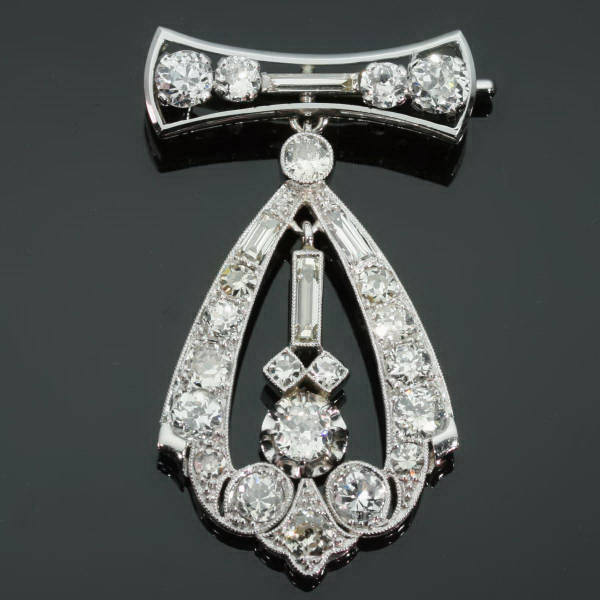


Diamond is the birthstone for the month of April, and besides being the most popular gemstone, it is also the anniversary gem for the 10th and 60th years of marriage. Even though the diamond is the hardest of all gemstones known to man, it is the simplest in composition: it is common carbon.
The ancient Greeks believed that diamonds were splinters of stars fallen to earth. Some even said that they were the tears of the Gods or perhaps crystallised lightning or hardened dew drops. The exact origin of diamonds remained something of a mystery for centuries.
In ancient times, only kings wore diamonds as a symbol of strength, courage, and invincibility. Over the centuries, the diamond acquired its unique status as the ultimate gift of love. It was said that Cupid's arrows were tipped with diamonds, which have a magic that nothing else can ever quite equal.
But you don't need to wait for Cupid to aim his arrow at your loved one. Check out our unique collection of original Art Deco diamond pendants to find your ultimate love gift.
Click here for all our diamond pendants.

Paradise-like Pastries
Antwerp, March 10th - In yet another attempt to stimulate the sales of their antique jewellery, The Adin Research Center for Antique Jewellery Commercialisation came up with the brilliant idea of hiring a new sales manager. Unfortunately, the background of this sweet man was not checked thoroughly, and it turned out that the only place he had worked before was in a pastry palace.
The only person happy with this choice, besides the pastry maker, was Adin's photographer.


Paparazzi plague even in The Garden of Adin!
Last week, an online magazine published what appeared to be photos of the Gardener's wife sunbathing in the southern part of The Garden of Adin, prompting strong condemnation from various directions.
Adin official, Mr. Elkan Wijnberg, condemned the decision to publish the images. "Mrs. Gardener of Adin had every expectation of privacy in their remote garden. It is unthinkable that anyone should take such photographs, let alone publish them. We are busy investigating the case and legal steps are being considered," he said.
Click here to find more info on this ring.

Unquestionable proof of VOGUE's great taste: Adin mentioned as one of the biggest antique jewellery sites in the world!

World shocking discovery: Tasteful life found in green spot on Mars
Antwerp, February 17 - Deputy of the Garden of Adin for NASA, chief scientist Elkan Wijnberg, told the Weekly Herald that the Mars rover had found something in a green spot that "is going to be for the history books". This speculation centred around the fact that the surface probe has discovered evidence of tasteful organic life on the Red Planet.
“Finding Adin antique jewellery doesn't only mean there is life on Mars, but I think it certainly means there is good taste there. But what we have learned so far is that we have to be careful about what we say,” Dr. Wijnberg said. “We’re doing science at the speed of light. So let's wait for the final outcome of our tests.”
Click here to find more info on this ring.

Valentine sentiments
Go green this Valentine's Day! Adin antique jewellery is to be considered eco-friendly jewellery. How much greener and better can it get? (And an important note aside: No harm was done to the plant while making this picture.)
Click here to find more info on this pendant.

New swan species discoveredin The Garden of Adin !!!
Antwerp, February 3 - In a recent expedition to one of the most desolate areas of The Garden of Adin, a new bird species has been discovered. An extremely white enameled swan with a black beak paddling in a pool of rose-cut diamonds. It is believed the swan has been floating around for at least some 100 years!
According to Adin's Chief Ornithologist (bird expert) Mr. Elkan Wijnberg, the swan moves every now and then, but strangely enough, only in the Adin Museum of Fairy Tale Artefacts. Once out of the museum, the bird refuses to move.
Click here to find more info on this brooch.

The Adin Museum Of Fairy Tale Artifacts proudly presents: The melted Snow Queen's necklace!
Last week, we updated our loyal readers about the unmeltable Snow Queen and her diamond necklace of frozen tears. But as most fairy tales turn out to be just fairy tales, the unmeltable Snow Queen turned out not to be weather resistible. When the Gardener of Adin made his weekly stroll through the Garden of Adin, he found her remains in a pile of melted snow, a carrot, and... the necklace! Both miraculously survived and were brought to The Adin Museum of Fairy Tale Artefacts, where they can still be seen today as irrefutable proof that the story of the Snow Queen was somewhat true!
Click here to find more info on this royal necklace.


The Adin Museum Of Fairy Tale Artifacts proudly presents: The Snow Queen's necklace!
Once upon a time... there was a beautiful Snow Queen who lived on the highest, most solitary peaks of The Garden of Adin. Since she didn't have a Snow King, she melted slowly away, tears dripping from her eyes. Her tears fell on the ground and turned into the most intensely sparkling diamonds people had ever seen. From these diamonds, the Gardener of Adin made her a beautiful necklace to cheer her up. And she lived happily and unmeltable ever after.
Click here to find more info on this royal necklace.

Smashing Art Deco Brooch
One smashing Art Deco brooch we have here. Made in platinum and set with no less than 9 carats of high-quality brilliant-cut diamonds. Art Deco is an eclectic artistic and design style which had its origins in Paris in the first decades of the 20th century. The style originated in the 1920s and continued to be employed until after World War II. The term "Art Deco" first saw wide use after an exhibition in 1966, referring to the 1925 Exposition Internationale des Arts Décoratifs et Industriels Modernes that was the culmination of high-end style moderne in Paris.
Led by the best designers in the decorative arts such as fashion and interior design, Art Deco affected all areas of design throughout the 1920s and 1930s, including architecture and industrial design, as well as the visual arts such as painting, the graphic arts, and film. At the time, this style was seen as elegant, glamorous, functional, and modern.
In the Art Deco period, abstract motifs and geometrical forms are quite typical. Art Deco moved away from the soft pastels and organic forms of its style predecessor, Art Nouveau, and embraced influences from many different styles and movements of the early 20th century, including Neoclassical, Constructivism, Cubism, Modernism, and Futurism. Its popularity peaked in Europe during the Roaring Twenties and continued strongly in the United States through the 1930s. Although many design movements have political or philosophical roots or intentions, Art Deco was purely decorative.
Click here to get to this smashing Art Deco brooch.


Miracles still happen in The Garden of Adin !!!
Once upon a time, there was a man who refused to pay his barber for shaving off his moustache. His argument? The barber hadn’t done his job properly, because the moustache kept coming back—faster than a weed in a well-watered garden! What the man didn’t know was that his barber came from a long line of magicians. With a mischievous glint in his eye, the barber cast a spell so powerful that the man would never be without a moustache again. From that moment on, every time he shaved it off, the moustache grew back instantly, thicker and bushier than before.
The barber, amused by his magical handiwork, had a picture taken of the man and hung it in his shop as a warning to future customers: beware of questioning your barber’s skills, for you never know what magical tricks they might have up their sleeves! Over the years, the shop closed, and the photo was lost... or so it seemed.
Now, with great pride, the curator of the Adin Museum of Fairy Tale Artifacts, Mr. Elkan Wijnberg, has uncovered this legendary photo—now preserved as a brooch—for his collection. This one-of-a-kind piece is part of the museum's new "Magical Moustaches & Misadventures" collection. Visit soon, and remember: be careful what you wish for at your next trim!
Click here to get to the complete collection ofthe Adin Museum of Fairy Tale Artifacts


