

Chronicles



Artistic Daydreams with estate jewellery from The Garden of Adin

For whatever it is you are celebrating, we're wishing y'all a great time!

You are an Adin VIP!

Artistic daydreams with antique jewellery from The Garden of Adin

Once upon a time, there was an artist visiting The Garden of Adin

Fashion changes, but style endures... (Coco Chanel 1883-1971)

Black cats may prowl,and pumpkins gleam, and this can be yours at Adin's Halloween!

Rare extra wide antique wedding bands from Zeeland in the Southern Netherlands
These extraordinary wide wedding bands are called "tonnenring" (Dutch for barrel ring). A typical regional piece of jewellery from Zeeland, the southern coastal part of the Netherlands, where every village had its own specific type of jewellery. Even more, every religion had its own distinctive differences in wearing and style.
In the county of Walcheren, this ring came into fashion in the second half of the 19th century (1850-1900). A wide gold smooth wedding band, sometimes engraved with a wreath of leaves and the initials of the bride and groom. It was virtually impossible to wear these rings while working, so they were only used to show off when going to church or at holidays and festivals. In pictures from that time, hands were often positioned to ensure all the rings would be visible. Such rings are also described in the book "Streeksieraden in Zeeland" (Dutch for "Regional Jewellery in Zeeland") on page 76.
Click here to read all about both antique Dutch wedding bands.

Once upon a time, there was an artist visiting The Garden of Adin

Halloween in The Garden of Adin, who still dares to buy?

Nostalgia for the 19th Century: Love, diamonds and sweet smells.

Ok, since you insist, just two more drops!

Sweet Antiquities From Antwerp (and still available)
Nineteenth Century sweeties from Antwerp. Antwerp, the home base of Adin, specialist in Antique Jewellery, is also home to "Elixir d'Anvers," a typical Antwerp wholesome liqueur that has been in existence since 1863 and is still being distilled and available. And so is the Antique Jewellery that Adin has pictured here.
Click here to read all about the pictured Antique Victorian enameled brooch.

Adin Proudly Presents: Adin's Vintage Select Hand Care Products
With many years of experience in the international body adornment market, Adin turns its focus to personal vintage hand care. It is with great pride that Adin introduces its line of Vintage Select Hand Care Products. This meticulously selected collection was created using only totally natural vintage ingredients and NOT tested on animals. Even more, Adin's Vintage Select Hand Care Products are perfectly safe to wear on either hand and an absolute joy for both hand and eye!
Click here see all our Vintage Select Hand Care Products.

In My Blue Heaven

Summer in The Garden of Adin, where even the pins on a cactus are pretty.

Summer in The Garden of Adin, where tendrils reach out as far as the Baroque era.

Lovely Summer Bouquets in The Garden of Adin...
Victorian bouquet brooch with rose cut diamonds.

Heavenly Summer in The Garden Of Adin
Heaven, I'm in heaven....
And my heart beats so that I can hardly speak
And I seem to find the happiness
I seekjust by browsing through
Adin's antique jewellery boutique

Summer in The Garden of Adin, a time to relax and enjoy
Art Nouveau bar brooch with diamonds and jade(Jugendstil)

Time flies in The Garden of Adin, and bejeweled flies too ...

Summer in The Garden Of Adin, perfect weather to play hide and seek

Antique French brooch, a mandoline (or domra)
An exquisite depiction of a Russian mandoline or domra brooch, rendered in a combination of 14K red gold and silver, featuring diamond, ruby, and pearl details as well as enamel inlay ornamentation. The body of the mandoline and the ribbon attached are executed in silver, set with a row of diamonds as are the soundhole and the decorations under the bridge. The top and bottom bridges are decorated with cabochon ruby bridgepins. Next to the chords on the body, two seed pearls and two blue enamel inlay details are added. This antique jewel bears pre-revolution Russian hallmarks for 14K gold. Hallmarked in Transcaucasia, known because of the letter 'O' in the hallmark, this hallmark was used between 1908 and the Russian Revolution in 1917. Furthermore, we found a French control mark that indicates that the piece has been imported into France... If this piece could only talk, what amazing story would we hear?
UPDATE: We have gained new insights regarding the origin of the brooch. The hallmark, an eagle's head, is a French stamp used for items made in France, as items made abroad and imported into France would have a different import stamp. Additionally, the location of the Russian stamp is not the typical place where jewellery manufactured in Russia would be hallmarked by the Russian assay office. All this leads us to revise our initial conclusion, and we now describe it as made in France and imported into Russia.

Art Nouveau brooch, symbolizing a new beginning.
Some info on the style Art Nouveau: Art Nouveau (French for New Style) is an international movement and style of art, architecture, and applied art—especially the decorative arts—that peaked in popularity at the turn of the 20th century (1890–1905). The name "Art Nouveau" is French for "new art". It is also known as Jugendstil, German for "youth style", named after the magazine Jugend, which promoted it, and in Italy, Stile Liberty, from the department store in London, Liberty & Co., which popularised the style, and in Holland as "Sla-olie-stijl", Dutch for "salad oil style" after an advertisement poster for this product that was made in that style.
Some info on the flower used as an ornament: Snowdrops - At the end of winter, when nature seems dead and the earth shrunk by cold, as an emblem of promise and consolation, the snowdrop is the first to announce spring and long bright days to come.
A cute history: The Russian Empress Catherine The Great (1729-1796) was a great lover of snowdrops. Once she installed a guard to protect a particularly large snowdrop from being plucked. The guard post remained there even when the reason why was long forgotten. Many decades later, Emperor Alexander II (1818-1881) noticed this guard post and wondered why there was a guard post when there was nothing to protect. It was then that the original reason was recovered.
Click here to read more about this interesting Art Nouveau brooch.

World Cup Football Thoughts: The formula for my happiness...
"... a yes,
a straight line,
a goal."
Friedrich Nietzsche, Philosopher, 1844-1900
(slightly adapted)
Click here to read more about this Van Cleef and Arpels diamond bracelet.

Antique jewellery in literature: Belle Epoque diamond bracelet by Emile Olive
Magnificent, stunning, and superb do not adequately describe this priceless Emile Olive bracelet which is in pristine condition! It is in typical Belle Époque style with Art Nouveau influences. Normally, rings would be adorned with this motif, and for us, it was the first time to find this motif in a bracelet. It includes 9 large old European cut diamonds weighing 3.40 ct and an enormous 7.20 ct in total (rose cut diamonds not included)! This very bracelet is depicted at page 533 in the "Bible of Antique Jewellery" namely "La Bijouterie Française au XIXe Siècle by Henri Vever, part two, Second Empire 1850-1870" printed in Paris in 1908. This book was translated into English in 2001 and is called "Henri Vever - French Jewellery of the Nineteenth Century". The bracelet is depicted on page 1025 of the English version.

Antique jewelry in literature: 17th Century Antique Portuguese Pendant
Antique Portuguese sequilé style pendant featuring 33 rose cut and senaille diamonds held in a foiled gold setting. The gold openwork surround features a sinuously scrolling foliate design in a lozenge shape traditional for sequilé-style jewellery and features five teardrop-shaped pendants, balancing the intricate design. The bigger diamonds are rose cut and the smaller diamonds are senaille cut. According to the experts of the Victoria & Albert Museum, it is characteristic of Iberian gold jewellery at this date that the gold settings nearly enclose the smaller diamonds. Pictures of similar pendants can be found in "A Sparkling Age: 17th Century Diamond Jewellery” p. 215 - by the Diamond Museum in Antwerp - published in 1993 and in "Five Centuries of Jewellery" p. 45 - by The National Museum of Ancient Art, Lisbon - published in 1995.

Art Deco Bar Brooch, Art deco jewellery in its utter beauty
1920’s platinum, pavé-set diamond and sapphire brooch. The design features three large old European cut diamonds interspersed by two half-moon cabochon cut sapphires surrounded by diamond-set millegrain-bordered openwork flower petals. A network of millegrain openwork lines and a row of 19 small rectangular cabochon sapphires connect these design elements.

Rose Cut Diamonds, another "romantic" explanation...
Once upon a time... a long long time ago, soirées (French for "soirees") were illuminated by romantic glimmering candle lights, smelly oil lamps, and asphyxiating smothering torches. And all jewellery set with rose cut diamonds were shining and sparkling as beautiful as can be, and all the people were happy (deep sigh)... To many antique jewellery experts, the reason why goldsmiths of those days used rose cut diamonds in antique jewellery was so the jewels would sparkle better in the candle light. We, however, wonder in what other than the light of candles, oil lamps, and torches rose cut diamonds had to sparkle, since there wasn't any electricity yet. Fact is that because of the irregularity of the polishing of the diamonds of those days, they have a nicer, less predictable, sparkle than new cut diamonds, which we find "a bit cold".
Click here to get to this magnificent pair of rose cut diamond earrings.

An arty mind is a joy forever...


Aloe Vera from The Garden of Adin, wear our jewellery 100 years and you'll live long!

Another planet with rings found!
Antwerp, 11 May 2014 - Scientists at The Garden of Adin have added another celestial body to the short list of objects in our solar system that have rings: a remote asteroid that orbits between Saturn and Uranus in the outer solar system. Researchers published a study in the journal Nature showing evidence of rings. Chief of Adin's Heavenly Jewellery Department for NASA, Mr. Elkan Wijnberg, said the discovery came as a complete surprise. "We weren't looking for rings and didn't think small bodies like this asteroid had them at all. We are in extensive negotiations with NASA to visit this near-Earth asteroid and redirect it, together with its antique ring, back to Earth," he said in a statement.
Click here to get to this diamond ring with boulder black opal.

We just like to keep it to our roots, for no particular reason...

Jewelry suitable for outdoor games, like playing domino in open air cafes in Paris...

The Adin way of decorating eggs, Easter fun in The Garden of Adin
The History of Adin's Easter Egg Tradition - In the Garden of Adin, the tradition of decorating eggs with antique and estate jewellery is an ancient one. These eggs, which may be left by the Easter Bunny, are hidden for women to find on Easter morning. They may also be placed in a basket filled with straw to resemble a bird's nest. The exact location of The Garden of Adin is kept a well-hidden secret, accessible only to those fortunate enough to be on Adin's mailing list.
Click here to get to this sapphire and diamond Art Deco ring.

Release new atomic clock. Ground shaking consequences for Antique Jewellery Trade!
Antwerp, 13 April 2014 - Timekeeping, which was already a pretty precise science involving lasers and atomic particles, just got even more exact. A new atomic clock, so accurate it will lose or gain only one second every 300 million years, was unveiled Thursday by the National Institute of Standards and Technology, a branch of the U.S. Department of Commerce (source: CNN). "With the release of the new atomic clock not only can we measure more accurately the time we live in but it allows us to date the age of our Antique Jewellery more precisely," said Mr. Elkan Wijnberg, chief engineer at Adin's Institute of Styles, Standards and Technology. He continues: "Imagine the thrill we had when we realised that the Art Deco period was a staggering 0.00003 nanoseconds longer ago than we always thought." And he continues: "We are not 100% sure yet, and more tests have to be done, but we have strong indications that other styles are also importantly affected by this new clock. History books might have to be re-written!"
Click here to get to our complete Antique Jewelry collection.

Adin's egg-cellent collection
We proudly present: The Adin dual-usage Easter egg-cup ring! Simple and easy to use, it can hold practically every little chocolate egg, and at the same time, it makes for a great present as an eternity band.
It's amazing and most probably going to be found on many ladies' wish lists. It's definitely the most sophisticated multi-usage jewel we have seen in years.
Click here to get to our egg-cellent collection of eternity bands.

Let us color your day...
Strong design Art Deco platinum diamond ring exquisitely designed with a dazzling 25 old mine cushion brilliant cut diamonds, displaying strong geometric influences. The design, featuring several smaller rectangles and squares radiating from two larger, central squares, overflows onto the decorative gallery of the ring, incorporating the whole of the ring and creating a slightly domed effect.
Click here to get to this Art Deco ring.

One swallow does not make a spring... (Aristotle 384 – 322 BCE)

Love, destiny and quality... The Red Thread Through Adin's Antique Jewellery Collection
The red thread of destiny is an East Asian belief originating from an old Chinese legend. According to this myth, the matchmaker god ties a red cord around the ankles of those that are to meet one another in a certain situation or help each other in a certain way. The two people connected by the red thread are soulmates, destined lovers, regardless of time, place, or circumstances. This magical cord may stretch or tangle, but never break. Adin's Antique Jewellery is bound to many strings in various hues of red. To which one are you and your loved one connected?
Click here to see all our antique and estate jewellery.

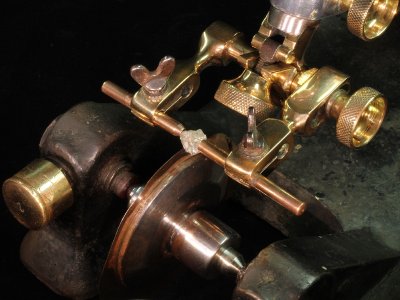
Diamond tools through the centuries
The machine depicted here is an old diamond saw, used since the Industrial Revolution around 1760. A rough diamond is held between two copper rods against a fast-rotating copper plate coated with diamond powder, effectively sawing the diamond. This sawing process could take up to several hours for a single cut!
The use of this device required the expertise and experience of a seasoned craftsman, who generally had several saws under his supervision at the same time. This method is opposed to modern sawing and cutting techniques, which mostly run automatically. The position of the brass ball on the other side of the lever is used to adjust the pressure of the diamond against the rotating blade.
It is because of this manual labour that older cut diamonds aren’t always as perfectly symmetrical as their modern cut counterparts. To us, the standards of cutting that apply to modern cut diamonds are in no way transferable to old cuts. Moreover, at Adin, we find that it is exactly these little "flaws" (by modern standards) that remind us of the artisanal way of the old days and what gives antique jewellery its charm.
Click here to get to our antique and estate diamond jewellery.


Lollipop Lollipop
Oh lolly lolly lolly
Lollipop Lollipop
Oh lolly lolly lolly
Lollipop Lollipop
Oh lolly lolly lolly
"pop"
Click here to get to this huge red stone ring.

Copper, the unexpected link between antique diamonds and charity.
What you see here in the picture are diamond tools and a platinum ring with an old cushion cut or Peruzzi diamond dating back to the early 18th Century. The tools are diamond holders for polishing diamonds. The one in the foreground is how they were used in the 18th century, and the one in the background is from the 20th century.
The holder in the front has a leaded point on a brass half-sphere attached to a copper stem. Diamond polishers would heat the lead so it would become moldable to embed the diamond in. The copper stem was inserted into a wooden tool, allowing the polishers to easily hold the diamond against a polishing wheel. To create the many facets a diamond has, they had to bend the copper stem into the desired position.
Later, the brass and lead were replaced by an iron tool (the diamond holder you see in the back), which allowed the polishers to easily change the stone from its holder. However, the copper stem remained. When you bend a metal many times, it will eventually break, and such was the case with all these copper stems.
In 1905, the Dutch Diamond Workers Union agreed with the owners of the diamond polishing factories that from then on, the Union would receive all the broken copper stems. A special fund, the "Koperen Stelen Fonds" or KSF (Dutch for Copper Stem Fund), was founded, solely funded by the revenues from these broken copper stems, to provide financial support to diamond workers affected by tuberculosis.
Later, in 1919, a similar agreement between unions and factory owners was made for the recuperation of used diamond powder (needed to polish diamonds). With those revenues, the KSF purchased a farm, which was converted into a sanatorium.
Click here to view this special old cut Peruzzi diamond.

Natural Seed Pearl Jewellery (Georgian period 1714-1830)
Not an everyday object, to say the least. A parure (a set of matching jewels) of real natural seed pearls, some 200 years old and in the finest condition, comes in its original box from the jeweller: Hamlet. His sign reads: "Hamlet Goldsmith & Jeweller To Their Majesties & Royal Family, Princes Street, Leicester Square".
Natural seed pearls (smaller than 2mm and not completely round) were an essential part of Georgian jewellery. They were made into long tasseled sautoirs, threaded into intricate designs to support slides and clasps, or used as surrounds for gemstones, cameos, and micro mosaics instead of the more traditional diamonds. Particularly exquisite are the parures of seed pearls in various sizes, sewn by hand with horsehair or silk thread onto a drilled mother-of-pearl backing to create necklaces, hair ornaments, and earrings of delicate beauty.
Due to the size of the seed pearls, special care and patience were needed when drilling the holes, as even the smallest mistake would result in the loss of value or render the pearl completely useless. It was an art Indian lapidaries were especially famed for, due to the extensive use of seed pearls in traditional Indian jewellery.
For all its fragility, a good deal of seed pearl work has survived, and fine examples in boxed sets can still be found. Pearls have always had a beautifying effect on women. (From the book "Georgian Jewellery 1714-1830" - where on page 153 you can see some jewellery that came from the Adin collection). Purity and innocence are characteristics often ascribed to pearls, combined with the purity attributed to the lily depicted in the necklace, making them an ideal wedding gift for a blushing bride.
The well-known story of Queen Cleopatra, dissolving a pearl into vinegar and drinking it to showcase her wealth to Caesar is often disregarded as myth. But there are records of Ranjit Singh, a nineteenth-century party-loving Indian prince who threw decadent parties where he would grind pearls to a powder and mix them with wine to offer to his favoured guests to impress them.
We don't suggest giving this necklace the Cleopatra nor the Ranjit Singh treatment, just wearing it will suffice to impress your friends.
Click here to read and see more about this seed pearl necklace.
Eureka! The most devious way to test gold.
The most famous story about Archimedes (287 BC – 212 BC) goes as follows: King Hiero II gave a goldsmith pure gold to make a crown for him. However, the king doubted the honesty of the goldsmith and tasked Archimedes with finding out whether the gold had been tampered with by adding silver, without damaging the crown.
According to the story, as told by the Roman writer Vitruvius, Archimedes was taking a bath when he noticed the water level rising, leading to his discovery of what we now know as Archimedes' principle (a body immersed in a fluid experiences an upward force equal to the weight of the fluid it displaces). So thrilled was he with this discovery that he leapt out of the bath, forgot to get dressed, and ran through the streets shouting "Eureka!" (I have found it!). The test on the crown was conducted, and indeed, silver had been mixed in.
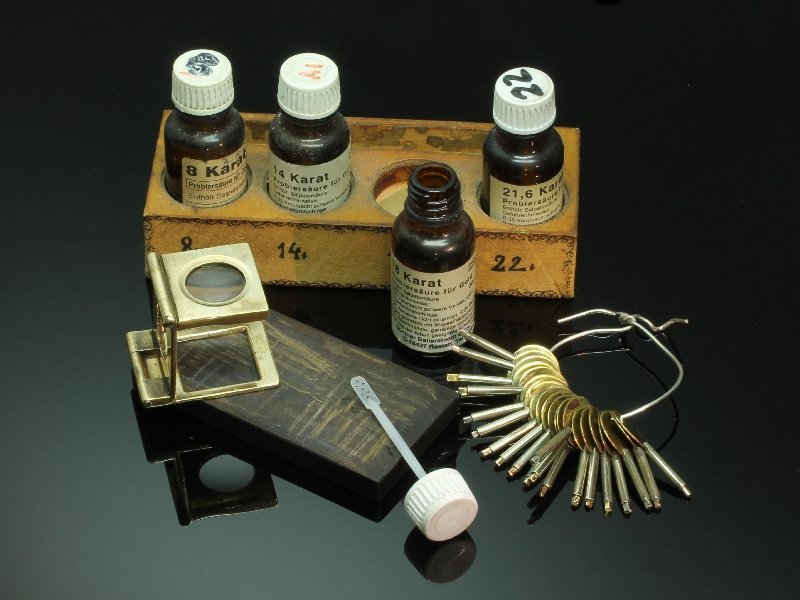
But here the myth starts to unravel. Although it’s a fascinating tale, literature suggests that this story is likely more of a well-told anecdote than a strictly historical event. Vitruvius recorded the story more than 200 years after it supposedly occurred, casting doubt on its accuracy. Moreover, Archimedes could have used a much simpler and more accurate method to test the gold—the touchstone and acid test, a technique known centuries before his time.
The story also fails to mention whether the crown contained stones or hollow spaces, which would have made the water displacement method less effective. And how pure was 'pure' gold at the time? In those days, gold was around 88 to 90% pure, the best they could achieve. So, even if the bathtub tale isn’t true, it remains a wonderful story.
What ultimately lingers is the image of a mad scientist running naked through the streets after discovering something that, in the end, wasn’t really useful in our profession. But hey, it sure makes for a great story!
In the picture, you see a touchstone, some bottles of acid to test the various alloys, and some sample-needles with standardized alloys of gold, platinum, and silver as we use these in our daily work at Adin.
Our well-tested collection is available in most currencies.
Click here to view our well-tested collection.

Adin's candy store: Chocolates and other sweet Valentine delights

Contemporary jewellery, the future antique collectible - Chris Steenbergen (1920-2007)
Almost half a year ago, we were fortunate enough to acquire a significant portion of the personal collection of contemporary jewellery artist Chris Steenbergen. Since then, we have been diligently researching and studying his background, exploring where his jewellery has been exhibited and in which books he has been mentioned.
With this information, we have compiled a brief summary of Chris Steenbergen in our glossary. It has been an enlightening journey.
We view this as a unique opportunity for collectors to obtain a piece of future antique jewellery that will undoubtedly become a treasured collectible.
Click here to get to this gold and silver brooch: "the rope jumper"

Antique Jewellery, The Grand Victorian Period
French Victorian jewellery refers to the style of decorative arts during the Victorian era, a time known for its eclectic revival and reinterpretation of historic styles, as well as the introduction of cross-cultural influences from the Middle East and Asia in furniture, fittings, and interior decoration. Victorian design is widely regarded for indulging in an excess of ornamentation.
Experts typically divide the reign of Queen Victoria, also known as the Victorian era (1837–1901), into three periods, each lasting approximately twenty years: the Romantic Victorian Period (1837–1860), the Grand Victorian Period (1860–1880), and the Late or Aesthetic Victorian Period (1880–1901).
This piece is considered to be from the Grand Victorian Period.
Click here to get to this magnificent Victorian brooch.

An arty mind is a joy forever...
Playing with antique jewels,
With respect, yet plenty of cheer,
A sparkling style from days gone by,
That makes the collector in you appear.
An arty mind is a joy forever,
Art and history, lost to time—never!
Click here for more info on this diamond and sapphire Art Deco ring.


